
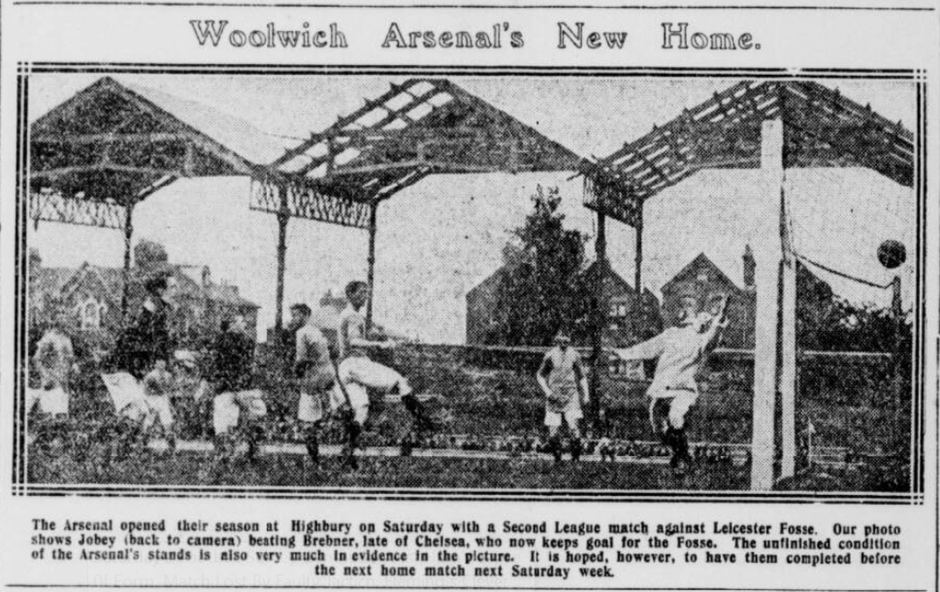
For 93 years, from 1913 to 2006, Arsenal’s beloved Highbury Stadium stood as a bastion of English football. Its iconic Art Deco stands, the famous Marble Halls, and the beloved Clock End etched it into the hearts of generations of fans. But what many might not realize is that the story of this North London colossus has an unexpected and rather significant opening chapter directly linked to Leicester Fosse.
In 1913, with Woolwich Arsenal facing financial straits and seeking a new home, chairman Henry Norris spearheaded a controversial move from Plumstead to a new site in Highbury, North London. Over the summer, a new stadium, designed by the prolific Archibald Leitch (responsible for many classic grounds), was hastily constructed. While not entirely complete, it was ready for the start of the 1913-14 season.
And who had the honour of being Arsenal’s very first opponents at their new abode on September 6, 1913? None other than Leicester Fosse, then playing in the Second Division. In front of a crowd of 20,000, history was made. Leicester Fosse’s Tommy Benfield etched his name into the record books by scoring the very first goal at Highbury, putting the visitors 1-0 up. While Arsenal eventually triumphed 2-1, with George Jobey scoring Arsenal’s first and a penalty sealing their win, the Foxes’ pioneering role in Highbury’s story remains a fascinating footnote.

A Shared History: Leicester City at Highbury
Leicester City faced Arsenal a formidable 54 times in League and Cup matches, yet their victories against the Gunners were remarkably scarce. Of these encounters, Leicester managed to win just four times: 3-1 in 1961, 1-0 in 1963, 4-2 in 1966, and 2-0 in 1973. Adding to their challenges, Leicester conceded a staggering eight goals to Arsenal on two separate occasions during the 1930s. One particularly notable clash occurred on May 15, 2004, when Leicester City visited Highbury for a Premier League fixture against Arsenal. This match saw the “Invincibles” of that season defeat Leicester 2-1. Despite a goal from Paul Dickov for the Foxes, strikes from Thierry Henry and Patrick Vieira secured the win for the home side. Though a loss for Leicester, this game was a memorable part of Arsenal’s incredible unbeaten league campaign and stood as one of the final Premier League encounters at Highbury before its eventual closure.
Upset at Highbury: City Stuns Portsmouth
While Leicester City’s overall record at Highbury against Arsenal might not have been brimming with victories, the stadium played host to one of the most glorious moments in the Foxes’ pre-Premier League history: the 1949 FA Cup Semi-Final triumph over Portsmouth. On March 26, 1949, a massive crowd of 62,000 packed into Arsenal’s Highbury ground, which served as a neutral venue for this crucial semi-final clash. Leicester City, then a Second Division side battling against relegation, faced a formidable Portsmouth team who were leading the First Division and would go on to win the league title that season. It was truly a David vs. Goliath encounter, and many expected Portsmouth to comfortably progress to Wembley.

However, under the shrewd management of Johnny Duncan (who, remarkably, was managing the club for a second spell after his controversial departure as a player years earlier), Leicester City produced a performance for the ages. Leicester’s hero on the day was none other than the legendary Don Revie, who would later become a hugely successful manager. Revie, who was then Leicester’s inside-forward and also Duncan’s niece’s husband, opened the scoring for City after just 5 minutes with a cool finish. Portsmouth’s Harris equalized in the 25th minute, but Leicester refused to be intimidated. In the second half, Leicester roared back. Ken Chisholm restored Leicester’s lead in the 47th minute. The turning point truly came when Portsmouth’s Harris missed a golden opportunity from six yards out, just after Chisholm’s goal. This miss seemed to deflate Portsmouth and invigorate the Foxes. Don Revie then sealed the victory and his brace in the 55th minute, scoring Leicester’s third goal.
The final whistle blew with Leicester City celebrating a sensational 3-1 victory over the reigning First Division champions-elect. It was a monumental upset and a testament to the team’s resilience and tactical nous. This famous victory at Highbury sent Leicester City to their second-ever FA Cup Final (their first since 1909), where they would face Wolverhampton Wanderers at Wembley Stadium. Although Leicester ultimately lost the final 3-1 to Wolves, that unforgettable afternoon at Highbury remains a cherished memory for City fans, representing a peak moment of FA Cup glory and a demonstration of their giant-killing capabilities. It was a day when Highbury, though Arsenal’s home, truly became Leicester’s temporary fortress for a triumphant semi-final.
The Evolution of a Landmark and its Modern Transformation
Highbury underwent significant transformations throughout its lifespan. The original Archibald Leitch design evolved, with the iconic Art Deco East and West Stands being rebuilt in the 1930s. These grand structures, with the East Stand’s famous Marble Halls, became architectural marvels in their own right. The North Bank gained a roof, and the south terrace was adorned with the famous “Clock End” clock. Post-Hillsborough, the stadium, like others across England, was converted to an all-seater venue in the 1990s, reducing its capacity from a peak of over 73,000 to just under 38,500.

By the early 2000s, with Arsenal’s ambitions growing and the capacity of Highbury becoming a limiting factor, the club decided to move to a larger, purpose-built stadium. The last competitive match was played on May 7, 2006, before Arsenal moved to the nearby Emirates Stadium.
In a remarkable feat of urban redevelopment, Highbury was then transformed into a residential complex known as Highbury Square. While the North Bank and Clock End were demolished, the stunning exteriors of the listed Art Deco East Stand and the matching West Stand were meticulously preserved, incorporated into the new luxury apartments. The pitch, once a sacred rectangle of green where footballing dreams were forged, became a beautifully landscaped communal garden for the residents. Even parts of the original tunnel and the Marble Halls were retained, offering a unique blend of heritage and modern living.