
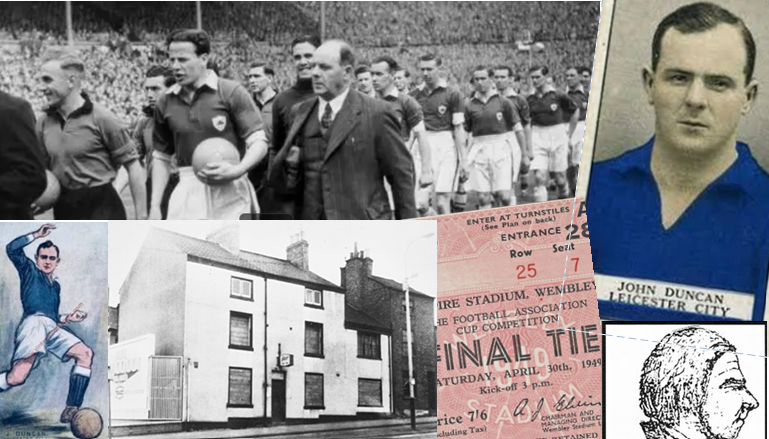
In the annals of Leicester City Football Club, few names resonate with the same enduring reverence as John “Johnny” Duncan. Dubbed “Tokey” by his peers, Duncan is rightfully described as “an indelible Leicester City great.” He was a pivotal figure in the club’s most successful period prior to the 2016 Premier League triumph, captaining them to their highest top-flight positions in 1928 and 1929, and later, as manager, leading them to the FA Cup Final in 1949. Yet, Duncan’s story isn’t just about football; it’s intricately woven with a local landmark: The Turks Head pub, a place that would become both his refuge and his enduring legacy.

Duncan’s arrival in Leicester in 1922, alongside his brother Tommy, was orchestrated by manager Peter Hodge, who had previously managed Johnny at Raith Rovers. Hodge, an astute judge of talent, was assembling a formidable team. With the Duncan brothers, particularly Johnny, Leicester City began to cultivate a distinctive “Scottish” passing style of play, which proved instrumental. This innovative approach bore fruit quickly, culminating in Leicester City’s triumph as Second Division champions in the 1924-25 season, ushering in a decade of unprecedented success for the club.
Johnny Duncan was more than just a player; he was a strategic thinker who, from 1922 to 1930, consistently implemented and refined Hodge’s passing game. This Scottish influence extended beyond the pitch, as all three of Leicester’s subsequent managers during this period were also Scots. Later, as manager from 1946 to 1949, Duncan would famously reintroduce the “false number nine” tactic to British football, notably with the legendary Don Revie, who was not only his centre-forward but also his niece’s husband (Revie married Tom Duncan’s daughter).
The Duncan brothers, born in Lochgelly, Scotland, were sons of a coal miner. Johnny himself followed his father down the pit during the Great War before his talent for football led him to Raith Rovers in 1919. By 1922, both Johnny, an inside-right, and his younger brother Tom, an outside-right, were signed by Peter Hodge for Leicester City. Johnny immediately became a first-team regular, while Tom, after a few seasons, moved on to other clubs before eventually settling back in Leicester with his family.

In 1930, at the age of 34, Johnny Duncan made a decision that would dramatically alter his football career: he announced his intention to take over The Turks Head pub in Leicester. His contract with Leicester City explicitly forbade such an endeavour, but Duncan, a man of conviction, insisted. The club’s response was swift and decisive: he was sacked. Duncan, in turn, chose to relinquish his football career to become the proprietor of The Turks Head, a role he embraced until his death in 1966.
The Turks Head occupied a prominent location at 107 Welford Road, directly opposite Welford Road Prison and also accessible from Infirmary Street at the rear. This commanding position lent itself to a rather grim spectacle in earlier times. Public hangings, a common sight on temporary scaffolds outside Leicester Gaol, offered a macabre form of entertainment, and the pub’s rooms provided a prime viewing spot. Even patients at the nearby Infirmary would watch from their windows.
The last public execution at Leicester Prison, on July 25, 1856, was a particularly notorious event. An estimated crowd of 25,000 gathered to witness the hanging of 33-year-old William “Peppermint Billy” Brown for the brutal murder of a 78-year-old tollgate keeper and his 10-year-old grandson. It’s said that Billy’s father, watching from The Turks Head, remarked, “Well done Billy, thou died a brick.” In a remarkable 21st-century twist, William “Peppermint Billy” Brown was symbolically “cleared” of the murder in a dramatised retrial held at Leicester’s Guildhall 167 years after his conviction. A jury of history enthusiasts re-examined the original evidence, supplemented by new research, and concluded that Brown should have escaped the noose.

The mid-20th century brought significant changes to Leicester. With the expansion of the Royal Infirmary in the late 1960s, the need for a visitor car park opposite what is now the “Old Main Entrance” or “Queen Victoria Wing” became paramount. This development necessitated the demolition of The Turks Head, along with other buildings in the triangular area extending to Pelham Street. The sale of the pub premises, covering 312 square yards, was completed by Bass Limited on March 29, 1971, for an agreed price of £12,900. A hospital car park now stands on the site where The Turks Head once proudly stood.

Despite the abrupt end to his playing career with Leicester City, Johnny Duncan’s connection to the club did not cease. In 1933, his nephew, American international Alex Wood, also from Lochgelly, was recruited by Leicester. Fifteen years after his controversial departure, and still running The Turks Head, Duncan was rehired to manage the club after the war. With key players like Don Revie, he revitalized the team, taking them to the FA Cup Final. However, another disagreement, ostensibly over transfer policy but likely due to board interference, led to his second sacking in late 1949. In the 50s and 60s the Turks Head was the apparently the sporting centre of Leicester, with the following famous people popping in for a chat over a drink:, John Arlott (sandwich in sitting room and sherry before the LCCC cricket match at nearby Aylestone Rd), media people-newspaper people, David Coleman, Jimmy Hill, Alex James, Matt Busby, and Arthur Chandler.
Johnny Duncan passed away in his beloved pub in 1966 at the age of 70. He is buried in Leicester’s Welford Road Cemetery, alongside his father-in-law and his brother Tom, who died tragically young in 1940 at just 40.