
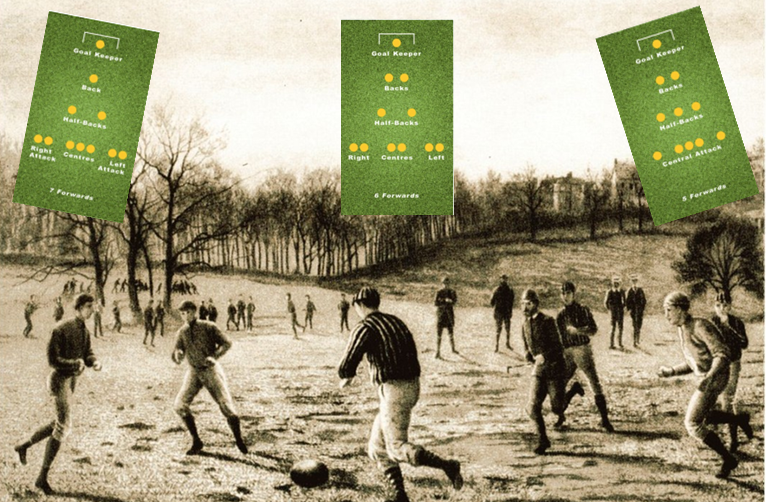
The development of Association Football tactics in the nineteenth century was a gradual process, initially characterized by a more rudimentary and less structured approach compared to the sophisticated strategies seen in the modern game. The evolution was closely linked to the codification of rules, particularly the offside law, and the increasing organisation of the sport through the formation of clubs and leagues.
In the early to mid-19th century, football matches often resembled chaotic mass movements with most players focused on attacking. Formations were largely undefined, but if one were to describe them, they would likely involve a minimal number of defenders and a large concentration of players attempting to dribble the ball forward. A 1-1-8 or 1-2-7 configuration (excluding the goalkeeper) was not uncommon, emphasising individual dribbling skills over passing and structured teamwork. The early, stricter interpretations of the offside rule, which initially prohibited forward passes, further encouraged this dribbling-focused style.
A significant tactical shift began to emerge in the latter part of the century, spearheaded by clubs in Sheffield and Scotland. Sheffield teams started to utilize longer passes to clear defensive lines, demonstrating the potential of moving the ball through the air. The first international match between England and Scotland in 1872 is often cited as a pivotal moment. While England relied on their perceived physical superiority and individual dribbling, Scotland showcased a more coordinated passing game, achieving a surprising 0-0 draw. This highlighted the effectiveness of “combination play” over purely individual efforts.
The late 19th century saw the rise of the 2-3-5 formation, also known as the “Pyramid.” This is considered the first widely adopted and recognisable formation in association football. It involved two full-backs (defenders), three half-backs (midfielders), and five forwards. This system marked a move towards a more balanced approach, with players designated to specific roles in defence, midfield, and attack. The half-backs were expected to contribute both defensively and in supporting attacks, while the full-backs primarily focused on shielding the goal. By the 1890s, the 2-3-5 had become the standard formation in England and spread internationally.
The evolution of the offside rule played a crucial role in shaping tactical development. The initial strict rule limited forward passing. However, a key change in 1866 allowed forward passes as long as at least three opposition players were between the receiver and the goal. This amendment gradually encouraged more passing and the development of coordinated attacking moves.
The success of Scottish clubs and the Scottish national team in employing passing and teamwork significantly influenced English football tactics. Players from Scotland, known for their emphasis on passing and movement, were recruited by English clubs, particularly in the north. Teams like Preston North End and Blackburn Rovers, under the guidance of figures like William Sudell and Tom Mitchell, adopted what was known as the “Scottish style,” which prioritized passing over individual dribbling. Preston North End’s “Invincibles” season in the inaugural Football League (1888-89), playing a form of the 2-3-5 with a focus on passing, demonstrated the effectiveness of this approach.