
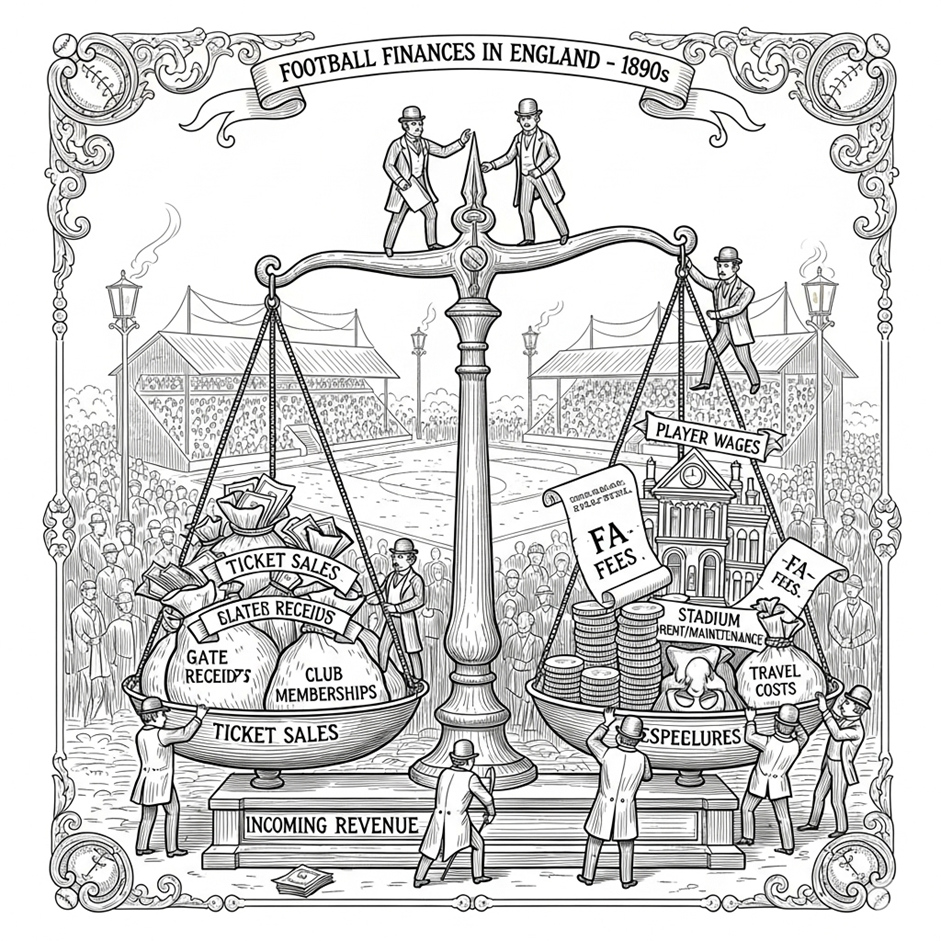

The result of my efforts in going through many official accounts and reports, in order to calculate the receipts of the Football League clubs for one year, is, I must admit, not less surprising to myself than it must be to all who are unofficially connected. The period in which the facts and figures here set forth were recorded was the twelve months ended on April 30th last; and, with due allowance for the fact that previously the League was not as strong numerically, they may be accepted as a fair representation of the importance and extent of its average business yearly for seven or eight years at least. I say I am surprised. The approximate turnover has never been officially reckoned before. I expected to work out a big sum, but when it came to £183,726 I thought of Dominie Sampson, and mentally exclaimed: “Prodigious!’” That, truly, was the gross income of all the League clubs last season. If there is any error at all— l believe there is not, for the returns have been compiled with every care exercised to verify them— it is certainly not made in trying to make the figures appear higher than they should be. All the figures l am giving may in fact be taken as the minimum. Of the £183,726 the clubs of the First Division received the larger share, in the proportion of much more than two to one; they took £130,652, while the clubs of the Second Division received £53,074. Not all this money, let it be understood, was said for admission, for that is not the only means of a club’s subsistence. The money taken at the gates end received for tickets by thirty-four clubs (l have omitted Darwen and Blackpool, being unable to verify their returns) came to £163,302— that is, £116,550 in the First Division and £46,752 in the Second Division. It is said that you can prove anything by figures. The saying applies when they are supplied polemically. My figures are not set forth for the purpose of any controversy, but, in minds which they most strongly impress, different thoughts and ideas will, no doubt, consequently occur. With a thought that has occurred to my own mind, which I mention without intending to be at all argumentative, there will, perhaps, be a general, if not unanimous, agreement, namely, that it is possible to estimate pretty accurately the total number of persons who paid to see the League clubs play last season by a calculation at the rate of sixpence per head. I make it, therefore, that the £163,302 represents an attendance of no less than 6,532,080 persons in the one season. That sum, it should be explained, was not paid solely to see League matches. It includes the money paid to see the League clubs in cup ties, with the important exception of what the Association received for its own purposes on account of the semi-final and final ties. The First Division clubs, out of the £116,550 which they received for playing, paid other clubs £10,815, while the Second Division clubs, out of their £46,752, paid other clubs £4,133, these “other” clubs being those who were concerned with them in cup ties. A noteworthy item is the amount received as transfer fees in the aggregate. Wouldn’t your readers who have sometimes been shocked by accounts of “trading in human flesh ” be a little surprised to know that in such an enormous turn-over the proceeds of the sales of players only reached £4,157? Of this the First Division clubs took £2,680, the Second Division clubs making £1,477.
Now, having given a general summary of the receipts, let us take a glance at the account of expenses in bulk. “Prodigious!” I exclaim again at sight of the first great item. There is fresh matter for statesmen and philosophers — those who talk and write about the nation’s marvellous progress in modern times — in the fact that the Football League pays annually considerably over £100,000 in wages! Last year (still confining myself to that period) the First Division paid their men £71,374, while the Second Division gave their employees £29,421, making a total, including bonuses, of £100,795. Yet this sum, huge as it was, did not completely settle the bill for services rendered. In addition, it cost the First Division £10,085 and the Second Division £2,628 for the employment of gatemen, policemen, referees, and linesmen. Then the work done in printing, posting, and advertising cost the First Division £3,028, and the Second Division £673. For medical attendance, required not only through accidents, but also in cases of sickness, the First Division paid £687, while the Second Division paid £326 ; and I think these figures — a total of a trifle over a thousand pounds for doctors’ bills — will be regarded by the public under whose notice they come as very satisfactory, indicating as they do a comparative immunity from the dangers which the game is supposed to involve. Captious critics and all who recoil from football, aghast with thoughts of its sanguinary nature, will see that they have extremely weak grounds in taking the doctors’ bills as the foundation of their objections to the game. These figures may serve for some very instructive comparisons. It might satisfy a lot of curiosity to see, if possible, how much goes to the medical profession in ordinary industries where the wage-bill is similar to this. The second largest item of League expenditure, generally speaking, tells of the advantage of football to railway companies and hotel proprietors. Last year these good people took £15,039 from the League, the first eighteen clubs paying £10,069, and sixteen of the second £4,920. It is impossible to say precisely what is the proportion of this £15,039 that the railway companies take, as the returns of the clubs give the travelling expenses without definite classification; but, having regard to the fact that those companies take not only the fares but a substantial lump as hotel proprietors also, it is not an exaggeration to estimate their receipts from the League at something like £12,000. This is trifling beside the stupendous pile they make in carrying the football public generally; and I have yet to learn that the railway companies are in any way extravagantly generous in their treatment of football organisations or individual officials and players in acknowledgment of the extra trade they put in their way. Total League expenditure last year, £133,261.
I am sure no reader has followed me so far in what I fear, important as the facts are, is somewhat dry reading without forming in this mind the question — Where and in what measure does football pay? As simply as I can give the answer it is contained in the following general facts: In the First Division ten clubs made an aggregate profit of £15,498, the other eight clubs losing altogether £2,698. In the Second Division a profit of £2,870 was shared by six clubs only, ten other clubs carrying on at a total loss of £2,081. It should be very clearly understood that I am dealing with the clubs exclusively as members of the League, and not in any way as members of the Association or other bodies in connection with which they look to make some grist. As a rule football pays where it is best in quality, but I am not sure whether (to suggest a possible exception to the rule) such a club as Bury would, as champions, secure as much patronage as Aston Villa if the latter were midway in the list.
Collectively, the League gains over £13,000 net a year. This is a fact which will specially attract the attention of the enthusiastic advocates of the pooling of gates and proportionate profit sharing. There is not, by the way, any foreign competition to fear. In football (almost alone as an “industry”) it does not arise, and I don’t think, in our time, it will. There is considerable variety noticeable under the same headings of income and expenditure when we look into the accounts of the clubs severally. Here are a few examples, taken haphazard:

These items sufficiently represent variety without going into a mass of details which lies before me. At a cursory glance, I cannot help noticing that whereas Aston Villa paid £81 in doctors’ bills, West Bromwich Albion paid only £6. Several of the Second Division clubs nursed their own sick and maimed without troubling any members, of the medical profession, The heaviest losers in the Second Division were Newton Heath, £475 appearing on the wrong side of their balance-sheet. Woolwich Arsenal (quoted above) made by far the greatest gain in the Second Division, Small Heath coming next in the order of profit-makers in that Division with £775. Luton lost £75 through their connection with the League. Bazaars were a good source of income last year to the Second Division clubs who were in need, accounting for £848. The heaviest gate-money in the year was the Villa’s £14,093, and the smallest (First Division) Bury’s £3,162. Small Heath’s gate was £5,157, the Arsenal’s £4,794, and Burton Swifts’ £935. Rent is an uncertain quantity, as the following figures, quoted in a column under the heading of “rent of grounds, &c.,” readily indicate – Villa. £384 0s. 6d. ; Blackburn Rovers, £111 18s 3d; Bury, £77 6s. 8d; Derby County, £246 4s 10d; Everton, £253 15s.; Notts Forest, £71 8s 4d; Newcastle, £139 14s. 6d; Preston North End £128 6s. 5d.; Stoke, £60 7s. 2d.; Sunderland £72 8s. 1d.; Sheffield Wednesday, £73 19s.; Wolverhampton Wanderers £150; West Bromwich Albion, £94 0s. 7d. ; Burslem Port Vale, £45; Leicester Fosse, £66 9s.; Lincoln, £37 13s. 10d.; Loughborough, £35; Newton Heath, £111 0s. 6d; Small Heath, £172 16s; Woolwich Arsenal, £180; Manchester City, £188 18s. 7d.. These figures are significant. The rent is, of course, heavier in the populous places, but the situations in many of them are inconvenient of access. There is no ground where the main entrance is in closer contiguity to a railway station than that occupied by Woolwich at Plumstead.
The subjoined tables will be perused, perhaps, with considerable interest:

The cost and value of goals cannot be well defined, but to the wealthiest club — Aston Villa — there was a very substantial gain, each League goal being equal to something like £40 clear profit to them.
My figures, as I have said, have reference to the year which included last season. As to the current season, judging from what has transpired in the past two months, and having regard to the enterprise and vigorous health of the clubs, and to the wonderful manifestation of public interest in the game as played by the League, I firmly believe that, whereas the general expenses may not be increased (in some cases the wages bills will go down), the aggregate income will be still heavier.
Leicester Chronicle – Saturday 04 November 1899