
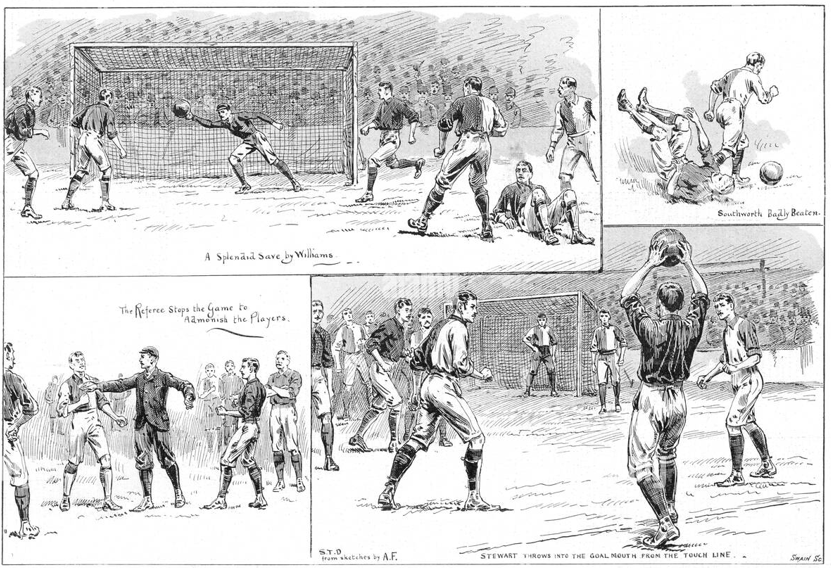

The League Management Committee have appointed the referees for September; football clubs have their players to present themselves practice, and hundred and one other incidents indicate that the end of the close season is approaching, and that we are on the eve of another winter’s campaign. How much more popular the coming season will be than its predecessors remains to seen, but, as yet, the League has not gone back, and I fail to detect the least evidence of diminishing influence. I am often asked to what extent the League has been responsible for the tremendous hold which the game has obtained upon public favour. My impression is
THE LEAGUE IDEA WAS DEVELOPED JUST AT THE RIGHT MOMENT,

and that but for the scheme the game would most likely have ceased to occupy prominent place amongst our national pastimes. Friendly encounters were rapidly losing their hold on the public. The English Cup competition had the whole of its interest crammed into the end of the season, and enterprising publicans vainly endeavoured to rivet public attention by organising more or less bogus competitions, which were conducted under rules and regulations framed themselves. The senior clubs plunged into professionalism soon it was legalised, and reckless expenditure produced impoverished exchequers. There can be no doubt that professionalism tended to improve the game, and the contests were keener than ever, but there was no sustained interest such as the county cricket championship provided, and it was to rectify this that I summoned meeting of the principal football clubs in the country and submitted the League scheme. Bolton Wanderers and Preston North End were then in the heyday of their power, and they thought so little about the business that they did not take the trouble to send representative. I may say that
THE INDIFFERENCE OF THE LANCASHIRE CLUBS.
The conference adjourned for week, and the interim West Bromwich Albion administered unexpected defeat to Preston North End in the final tie of the English Cup, and the proud Prestonians altered their front. It is by no means improbable that but for the blow which North End got, the League scheme would have been seriously delayed. However, it ultimately got through and has made rapid strides ever since. There is scarcely a district in the kingdom which does not boast connection with a combination based on the League principle, and this expansion of interest in wholesome outdoor pastime is very healthy sign of the times. The League, however, has done more than spread influence into the remotest parts erf the country; has improved the style of play and elevated the tone of the players. Tears ago the football professional was commonly thought to be incorrigible rowdy, whose only qualifications in life were to kick something or somebody on the field and indulge in horse-play off it. Railway companies fought shy of football teams, and hotel proprietors would not cater for them if there was possible chance of inventing sufficient excuse. Some months ago a Rugby team put up at one of the largest hotels in the centre of Birmingham and could not resist the temptation to smash the other visitors hats and cut up their boots. Not unnaturally there was good deal of wrath expended by the victims of this idiotic joking, and the manager, when invited to accommodate the English team, which defeated Scotland at Aston, inquired whether they played Rugby or Association before would consent to house them.
EXPERIENCE HAS TAUGHT CLUB MANAGERS
that a good character is a indispensable good football reputation, and, by process of time, the unsteady and intemperate player has been extensively weeded out, and the general bearing of the average professional footballer to-day is all that could be desired, while, from playing standpoint, he has made the game, by careful study, an art. Combination attack is now met by a united defence, and there is longer any room for the brilliant individual play, such once characterised the Corinthians, whose style have always admired. Although there are still traces of the individual rather than combined action in the Corinthians of the present day, the methods of the famous amateurs are different from what they were prior to the advent of professionalism. They have adopted some of the main features of combined play and have thereby rendered themselves more effective. Haring popularised the game, improved the style of play, and brought the player op to higher level, the League may justly claim have accomplished useful purpose. has not been without its shortcomings, however, and it is against the continuance of these defects that great care will have to be exercised. Many clubs are fettered by financial obligations to serious extent, but they still adhere the paying of “bonuses for wins,” which I think wrong in principle. Players are paid big wages. In return for which clubs ought to get their best service. Other Inducements are held out, however, and when these extras are added the wages the figure taxes the clubs’ coffers. Pay players well, all means, and recognise special talent: but he occasion which has developed bonus business ought to be faced by managers with firmness
THE PAYING OF BIG SUMS TO PLAYERS TO SIGN
Is another institution which the system has, I regret to say, built up. There has been for years a clause in the League rules which makes it aa offence pay more than £10 to a player for signing, the efficacy of this regulation has been publicly disputed, and I have no doubt that the rule has been as often broken observed. From the very first I opposed the clause calculated to do no good. The signing a first-class player must be a question of supply demand obvious that thickly populated districts, where a club wants a particular player, they will outside the £10 rule to get him. Some people seem able to detect a redeeming feature in the regulation, but I am bound to say that I think it is absurd and will inevitably lead to deception. Now the Association have adopted the rule, it will very hard anyone who Is indiscreet enough to get found out; but the notion that there will be any such conscientious observance of the rule as to constitute barrier across the path of a club in search of particular footballer, is out of the question. It would have been better if the Association and the League had abstained from interfering with finances altogether, for the reason that they cannot do it effectively. What would happen supposing the Football Association adopted maximum wage for a first-class professional? The old trick putting money surreptitiously into the player’s pocket would be resorted to. The Association were powerless to check this dodge when was carried on extensively in the days of “amateurism,” and they would be equally doomed to failure if they attempted it now. Clubs ought to be left to regulate their own finances, and I would give the player just as much freedom in his engagements club has in employing him. That seems to the ultimate solution of the transfer problem. Another matter which has thrust itself on the Football Association is
THE REFEREES
There are so many complex considerations in this affair that it would be difficult thing to lay down a hard-and-fast rule for the control of the question. A man may have a thorough knowledge of the game and pass, with credit to himself, an examination regarding the off-side rule, and still make indifferent referee. Promptness and decision are essential qualities, and it unfortunately happens that these attributes are absent. Where there is weakness, and a suggestion of unfairness as well, the referee is doing the game an incalculable harm. The League can do much stamp out system of touting for engagements, and it will be good thing for the game .when club managers to have anything to do with the nomination or the appointment of referees. I advocated some years ago the advisability of reducing the number of club nominations, and this has length been done, but the turn of events has been contrary to what I had expected. Each League club now has the right to nominate two referees, but, if any person named is connected with football management, he is disqualified from officiating the division to which he belongs. This, I think, is going to work out unsatisfactorily. Why club managers want to interfere with refereeing all is more than I can understand. There are many reasons assigned for the nomination of committeemen and directors, but the general impression is that the move is nothing more than an attempt to convert football managers into poachers under the guise of referees. The presence of a responsible member of one club on the ground of another team might be viewed with suspicion, but the referee device might remove some of the difficulties. I should not like to say that any such motive is in the mind of anyone who has already been appointed, but I cannot help feeling that It would have been a wiser course to have abstained from accepting official responsibilities. Although it is not impossible for a club manager to act with strict Impartiality, there are many instances where favouritism has displayed itself with unpleasant prominence, and where there is chance creating suspicion of unfairness, I maintain that it is much better for club managers steer clear of the office of referee. The referee problem is one which has forced its way to the front, and, despite its many besetting difficulties, I do not despair of the commission finding some measure of redress. One thing is certain, that the solution is not to be found in the nomination of club managers by club managers to act under the authority of club managers. Such state of affairs rather indicates that we are drifting out of the correct course. In connection with the enormous growth of the League since was founded 1888-9, it worthwhile mentioning that Aston Villa, on several occasions, have taken more money at one fixture Aston than their receipts amounted to in the first season the League started. Last season over half-a-million people witnessed the encounters which took place on the Villa enclosure and the welfare of any healthy sport which caters for the public in such extensive way should be guarded scrupulously by those entrusted with legislative powers.