
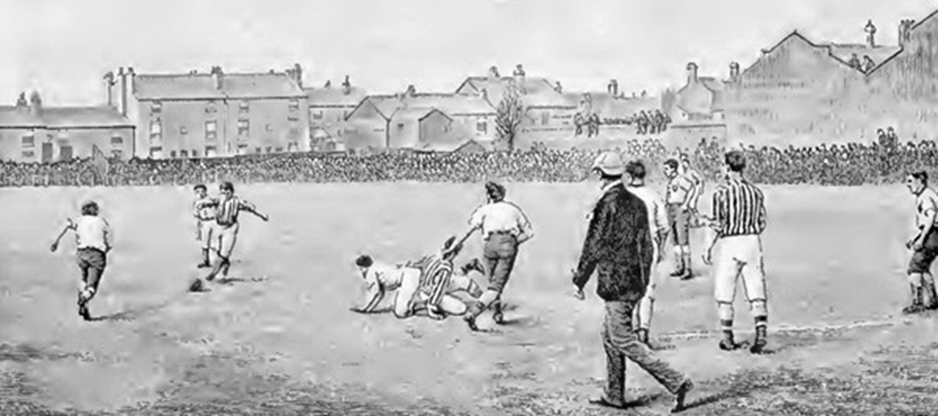

In dealing with the referee of to-day, and what he has to do and expect, I should like, in the first place, to emphasise the fact that the post is a most responsible one, for not only is football something more than a mere game — almost a science— but it is in the case of League clubs almost a matter of life and death, so much does there depend, often, on a single goal. In view of this fact, it is absolutely necessary that the “Man with the Whistle” should not only be free from any suspicion of bias, but fully competent to pass judgment on the ever-varying and often puzzling phases of our national game. This is not so easy as it looks to the average spectator.
In the first place I maintain that the good referee must be born and cannot be made. if a man does not possess, within himself the qualities necessary for a successful referee, he can never acquire them. He must be cool, prompt to form his judgment, and resolute to act upon it. What remains to be added to complete the good referee may be acquired, but, without these three essentials, he may never hope to command the respect of crowds which yearly become more critical, or of players who are quick to take advantage of a weakness.
Given these qualifications, the young referee should make himself thoroughly conversant with the laws of the game and with their applications on the field. My friend Mr. Woolfall, of the Football Association Council, the other day advised young referees to begin with junior matches and get “well knocked about ” before they ventured to referee in important matches. I thoroughly endorse this advice, with some amount of reservation as to the “knocking about.” A referee must not only be able to answer every problem submitted to him by examining boards, and so on, but he must be able to give a decision immediately on the field, which is a very different thing. In actual practice a referee has no time to think out his decision — he must have full confidence in his own judgment and have no fear of giving his decision even in the face of a hostile crowd. He should, indeed, endeavour to totally ignore the spectators, for if he once gives ear to their clamour he not only loses control of the game but is rewarded with the contempt of those whose favour he has tried to gain.
The first thing to which it is necessary that the referee should pay attention is his own physical condition. He requires to train almost as carefully as a player, for if he is to do justice to the game he will be on the run almost the whole ninety minutes and have to put in even more work than the average player. This is necessary because he can only see all that is passing by keeping close up to the ball, for the days of the ” dud ” referee are over. The man who stands still, in the centre of the ground, and rules the game from the middle ring has gone for ever, along with the gentleman who used to officiate in English cup ties in a long macintosh and umbrella; while the man who nowadays would attempt to confine himself to a dry piece of turf throughout the game, would soon find his occupation gone.
Having got himself “fit” physically, the referee should practice his vocation at every possible opportunity. I contend that it is impossible for anybody to referee properly unless he keeps in regular practice. I know that personally I would not accept an important appointment unless I felt competent by reason of previous practice. Things might go all right, of course, but on the other hand there would be a great probability that some point would arise which, for want of the confidence begot of practice, might create no end of soreness. There have not been wanting cases of men who have been very good referees in their time returning to the field occasionally and giving decisions which have not only damaged the game but materially impaired their reputations. In football, as in everything, a man must be up-to-date to be successful.
An important thing for a referee to bear in mind is that he is first and foremost and always the servant of the Football Association, who alone are the judges of his performances, and that the various Leagues, and combinations, and so forth whose matches he controls, have no authority over him except in the matter of his appointment. This power, of course, can be and often is used against an unpopular referee, but not openly, for the Football Association is, and rightly, very jealous of infringements upon its sphere. Although I see difficulties in the way of the Football Association taking over the control of the Referees’ Associations I have good hope that, with such men as we have at the head of the parent body, some workable scheme to that end may be devised. It has been suggested that the referees wish to make their own appointments, but I never heard of any such desire. While on this subject I should like to add that I think the Referees Associations would be doing a service to the game generally by refusing to allow the transfer of referees from one match to another to suit home clubs. If a referee is good enough for appointment at all, he should at least be protected from manoeuvres which are calculated to throw a doubt upon his impartiality. Such things, we shall be told, are never done— but all the same they happen. If referees, therefore, were secure from such well-intentioned interference their self respect would be materially strengthened, while an appeal to the Football Association would afford a ready method of investigating complaints which as it is are seldom thoroughly bottomed.
To return to the field. Football players are now much better behaved than they used to be, and few referees have to contend with threatening and offensive language such as was too common in the old days. There aro even now, l am aware, several very prominent players who persist in badgering referees, but there is a short and effective way with these gentlemen. I cannot deny that I have many times had my decisions questioned by these gentry in very coarse terms, but, on being told that a repetition of the language would ensure their being sent off, they invariably shut up. They know that I never warn twice, and that on a second offence there is nothing for it but marching orders. In this I contend a referee has no choice under the rules, although many of my colleagues act as though they had, and so we see players taking advantage of their failure to carry out their threats. A referee should always be firm with players and let them understand that he means what he says, but at the same time he should never refuse to answer a pertinent question asked by a player in a civil manner. Not even all our best players are fully conversant with the laws of the game, and so a civil answer will often not only turn away wrath at the moment but probably obviate much future friction.
A referee should never be afraid to stop rough play, and if necessary to send the offender off the ground for violent conduct. Such a step is, of course, a serious one for the player, but if it is not adopted the game may turn out to be a serious affair to some other player, and, perhaps, in the end for the referee, while in any case the game suffers. The bugbear of the referee who is not quite confident of himself is in such cases the crowd, and it is for this reason that I advocate the appointment of the same referee for the home and away matches of a club. The perfect referee has yet to be found, and until he arrives it would be fairer to let each home side in turn have the benefit of a weak referee, rather than a club should meet with a home-leaning official when they are away, and a sternly impartial referee on their own ground. This applies more particularly to League matches, where so much is at stake. If my suggestions were adopted we should, I think, soon find the crowds and the clubs all crying out for strong referees, and the weak men who cause riot and disorder would vanish from a field for which they were never fitted.
As I said before, the best way for a referee to deal with a crowd is to take no notice of it. It is foolish to get angry with it; for, after all, a referee is in a sense a public man, and as such he must submit to be a target for criticism. The crowd is entitled to its opinion, and to express it either by cheering or hooting. If the referee is inclined to be thin-skinned he should bear in mind that with 10,000 pairs of eyes closely watching him, and each pair seeing the game from a different position, it would be marvellous, indeed, if he did not occasionally get hooted. Anything beyond a good hooting is rare nowadays, for clubs are, very rightly, nervously anxious to preserve their ground from disgrace. Once or twice I have had occasion to caution noisy spectators that they were endangering the ground, and I have generally found the warning sufficient. At other times, like most referees, I have been kicked and struck while passing through the spectators to my dressing-room, and I have on different occasions been pelted with snowballs, turf, and things of that sort. The best advice I can give to a referee, under such circumstances, is to get into his room as quickly as he can, for it is of little use arguing with two or three thousand people, and almost impossible to spot your assailants. On all the leading grounds the protection afforded to referees is now almost perfect, and it is only rarely that a referee is molested. In the old days, twenty years ago, when there was nobody to report such matters to, a referee often experienced adventures which would sound incredulous to the modern young man who drives up to his dressing-room door, does his work, pockets his fee, and drives off to the station immediately the match is over without speaking to more than half-a-dozen people during the afternoon.
While a referee should, of course, blow his whistle for every violation of the laws of the game which comes under his observation, he should be careful to avoid “slowing ” the game. For instance, be should not wait for the men and himself to get into position before whistling for a free kick to be taken. The placing of the ball does not matter to a yard or two, and it is by no means necessary for the field to be reset before the kick, or what becomes of the advantage to the side taking it ? Everything should be done with a view to making the game fast, for then it is more enjoyable to everybody concerned and better football is played. The decision of the Association giving referees power to discriminate between wilful and accidental handling has effected a vast improvement in this way, contrary to the prophecies of the old stagers, who confidently anticipated a quick return to the old order of things. For several months we heard tales of forwards who made it a study to fist the ball through the goal “accidentally,” but these have not been heard of lately, and almost everybody now agrees that the reform was a capital one.
The most important kick with which a referee has to deal is the penalty kick. Referees should never be afraid of awarding this penalty for any infringement for which it is prescribed. I have often been twitted with my partiality for this kick, but I don’t mind that, because I believe it to be one of the most useful laws the Association ever enacted, and that it has saved the game from foul and dirty play as nothing else would have done. But referees should be careful to note that this law does not apply to violent conduct, for which offence the man should be sent off the field and reported to the Association. A lot of confusion was apparent in some quarters last season as to the meaning of the Association’s “instruction” that ” it is the duty of the referee to see that the kick is properly taken,” and many cases of undoubted hardship to teams occurred through referees neglecting this ” instruction.” Very seldom, indeed, have I found any difficulty, for I simply get the men back to the eighteen-yard mark, and warn them that if they step over the line before the ball is kicked I will send them off the ground. To save them from the start forward which players unconsciously make when the kick is signalled by a whistle, I merely ask the kicker and the goal-keeper if they are ready, and, receiving an affirmative reply, I say “All right — go along.” I recommend other referees to try this method of avoiding disputes.
In conclusion, let me advise any young man who thinks of taking up refereeing for the sake of the money he may make to drop the idea at once. But, if a man has abundant leisure, robust health, and a genuine enthusiasm for the game, he may, as I have, pass many a pleasant hour in performing the work of that much condemned, but indispensable official, the football referee.
Leicester Chronicle – Saturday 30 September 1899