
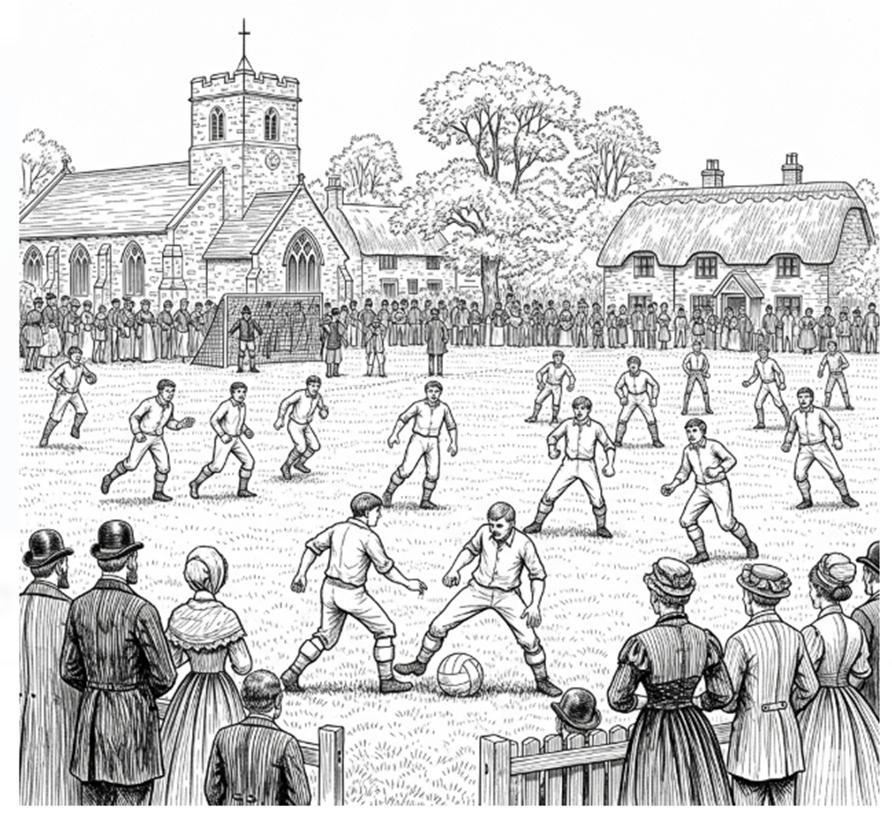

There is no reason why every village in the country should not have a football club. Even in agricultural parishes the farm labourers have enough spare time to visit the village inn or spend hours at some favourite corner, to the annoyance of the villagers and passers-by. Now, I have proved very conclusively that if these men had a chance of participation in such games as quoits, cricket, or football they would most readily join in them, and would thus save their money, their time, and their character, besides being far and away better men at their next day’s work. Some years ago a young friend, who was very keen on football, asked me to help him to
START A CLUB IN OUR VILLAGE.
The farm servants entered into the thing heartily. Not to dip too heavily into their purses, we arranged that one shilling each should constitute membership, and we then asked the farmers and tradesmen to help us. The latter did so willingly, but the farmers at first objected, and said that if the men “slaved” at football overnight they would be worth nothing to them next day. I asked them how much they were worth after a night’s carouse. Of course I knew the answer to this, as I had frequently heard them complain about the worthlessness of the men for at least a whole day after the said carouse. Well, they promised to give the thing a trial. At first we only practised on moonlight nights, but that little caused the village inn to be less frequented. One of the leading farmers soon became quite an enthusiast, and he said that his fellow farmers agreed with him that the men, after a little stiffness from the first practice or so, seemed to be all the better for the game, and did not spend half the day in sleeping in quiet corners when they had the chance. We had no more trouble in this direction, and soon we began to think of
TRYING OUR SKILL IN A MATCH
against other clubs. Now came the difficulty as to time, but the men overcame their employers’ scruples by offering to make up any lost time. After a few matches there was no difficulty in getting a few hours for a game in the afternoon, and all the people in the parish seemed to enjoy a match as much as the players themselves. Even the innkeeper became an enthusiast. I asked him if he had suffered at all by our games, and his answer was a very Striking one. “No, sir,” said he, “I have benefited on the whole. Where I formerly sold three or four glasses to one man, I now sell one or two each to at least half-a-dozen, and an innkeeper would rather get his living this way than by taking nearly all the earnings of any one man and watch him go to ruin.” The members of our club became
STEADIER MEN AND MUCH BETTER WORKMEN.
In addition they had provided many an afternoon’s enjoyment to the rest of the parish. So much for the possibility of the game in a purely agricultural parish. In a colliery, ironwork, factory, or any other industrial district the men are not so much tied as their agricultural friends. The chief difficulty here is as to a suitable field for play. Many farmers object to let a field for football, as they think the grass gets injured by so much trampling and does not recover itself next summer. Never was there a greater mistake. When I was a boy in school in a country village, I shall never forget the delight all the boys felt when a farmer, who rented a rough grass field near the school, told us that we could play football in his field all the winter and up to April 1st. We thought he was the kindest old soul in the country, and the way we cheered him was a treat. He thoroughly enjoyed it, and his eyes gave a merry twinkle of delight. That old farmer well knew what he was about. Well, we used his field, and long before April we had
KICKED OFF ALL THE ROUGH TUFTS OF GRASS,
and our trampling made it appear more like a wide road than a field. During the April month that field recovered in a wonderful manner, and all through the summer it was the best bit of pasture land he had. I have often as a lecturer on scientific agriculture advocated more heavy rolling of pasture and meadow lands. One farmer who attended my lectures thought there would be no harm in trying it, and the result surprised him. He bad better hay and better grass on bis pastures. On talking the matter over with him, he said: “I thought your remark about rolling the grass land were worth about as much as the rubbish you science fellows talk about, but I have proved that you were right in this case, and I shall think better of your class in the future.” Occupiers of land need not be afraid of
LETTING A PART FOR FOOTBALL.
Of course, they are not expected to let the land gratis, but they should not charge an exorbitant rent for it, as the damage in the football season is practically nil. Damage to the fences, I freely grant, is often a serious affair. Here the committee of the club should step in and assist them by putting up a notice board, barbed wire fencing, &c. Once a field is secured the rest should be plain sailing. The fee for playing members should be as low as possible, say 2s. or 2s. 6d. per year. Honorary members should pay from 2s. 6d. upwards. The rig out costs little, and is not like cricket, where every man is supposed to have flannels, bats, gloves, &c. As a rule, the club finds knickers and shirts, and so the players have little to pay out of their own pockets. The only heavy outlay would be for goal posts, nets, and fencing, and once these are obtained they do not require renewing for years. Concerts &c may be got up for this purpose.
TO START A VILLAGE CLUB PROPERLY
it is well that the most influential person in the parish should be chosen as president, provided such person will really take interest in the games. Vice-presidents should also be men of position, with the same proviso, while the secretary and treasurer should be thoroughly trustworthy and energetic men. Much depends upon the latter pair, and, if they are smart and good men, their club cannot fail. If the squire or parson can play fairly well, and are enthusiasts in this game, we need go no further for the captain. Either of these will do well, but if a working-man is a better player than either and has gained the confidence of his fellows, that is the man for captain, as he would be more in touch with the players. The captain must be a good player himself— firm, independent, decisive, and possessed of good sound common sense. If, on the other hand, he shows weakness and indecision, he not only forfeits the confidence and respect of his men, but he spoils them and the game.
A MASTERFUL CAPTAIN IS NECESSARY,
and it is wonderful the amount of hero-worship such a man gets from players and spectators. Whether his social position be high or low, it matters not. I know one such captain who is a servant to a gentleman, who also plays in the team. While a game is on positions are reversed, and the servant’s orders and commands have to be obeyed implicitly. In one practice game the squire passed the ball to the left wing when he should have passed to the right, and a probable goal was lost. “Here,” said the captain, “if you have no more gumption than that you had better be off.” The squire took this reprimand in good part and promised to amend. At the Hall, the servant knew his place and was most respectful and polite. Next day there was to be a match, and the squire told a friend, who was staying with him, that he would have to be on his best behaviour, for Bill, the captain, particularly wished to win. All three walked to the field together, and the squire, just for fun, pulled out a cigar and lit it. Bill at once, in a most peremptory manner, said:
“HERE, SIR, PUT THAT OUT AT ONCE”
You’ II want all your wind to-day ! ” Out it had to go. Fortunate is the team possessed of such a captain, and fortunate, too, to have a swell like the squire to set an example of implicit obedience. To attain any degree of proficiency in village football, there must of necessity be much practice, and here comes the difficulty. Practice with men who kick as if all their brains were In their feet is of no use. If the committee could treat the players to witness a game between first-class teams, the money would be well spent. If one, at least, of the members of the club had previously played in good games, he would be of immense value in initiating the men into such mysteries as passing, dribbling, &c. He would explain to them that kicking without “gumption” is useless. The players should be taught that
EVERY KICK SHOULD BE GIVEN WITH AN OBJECT IN VIEW.
A rule a friend of mine made for his men was this, and it is worth noting by all players. “The ball must be put to the best advantage for your side. If you can do this yourself, do it ; if not, give it to some- one who can.” This really, after some skill in the art of dribbling and tricking has been learnt, is the secret of good passing, and consequently good foot- ball. It is all rubbish to say that good football cannot be played by village teams. I know one village club whose players have on several occasions not only won the great cup of the district — open to town and village — but they have often gone well into the rounds of the English Cup. Now, how was this done ? At first it was the work of one man — the village schoolmaster — who was captain of his college team, and a rare good player, too. He took his men in hand and commenced properly by teaching them the science and art of the game. Soon he had one or two pupils after his own heart, and ere long football was played in this village in a thoroughly good, scientific manner, to the delight of all.
THERE WAS NO UNDUE ROUGHNESS
in the play or language of the players, and even the ladies in the parish were delighted to witness the games. At the present time every man in this team is a working-man, and yet their skill is so great that the public school in the county town, and one of the best in England, too, annually send an invitation to these villagers to play a friendly same, on the school ground, in order to get thoroughly good practice against scientific players. Now, what one village team have done others can do also. Life in villages, as a rule, is very monotonous, and anything which will brighten up a lot of the villagers is to be heartily welcomed, but to be of lasting use it must be good, and this is as true of football as of anything else. Poor football, by which I mean aimless kicking of the ball, with unnecessary roughness, will not last, and will do more harm than good for the time it does last. The chief hindrances to good football in villages are these:
Rough play.
Coarse language.
Lack of interest by the upper class.
Bad or weak referees.
Want of club room, other than the village inn.
ROUGH PLAY SHOULD BE PUT DOWN AT ONCE
by the captain and discouraged by those having any influence in the village. It not only spoils the game, but ends disastrously to the players, and many a healthy young fellow has been seriously damaged for life by reckless kicking and charging. The very men who show roughness are often the ones to suffer, Here is an instance, and, sad to say, a time one some years ago I was referee in a game which ended in a draw. I had to caution one man for rough play. Before replaying the game this man was heard to say that his team should either win or there would be some cripple, on the other side. The game had not been in progress five minutes ere he began his work by hacking at a player most spitefully. Somehow their legs crossed, and he fell with a broken one. It was a terrible fracture, and not only were his football days over, but he has been a cripple since. He had no pity from anyone, and the general verdict was “Serve him right.” Parents who have any regard for the future of their sons will not allow them to play with such man. Quite right, too; but
MANY A GOOD PLAYER IS LOST TO A CLUB
through this. Unfortunately, too, many spectators like to see man “bowled over,” and encourage it. Some years ago I took an uncle of mine— a jolly old farmer— to see a Cup Tie. The first part of the game was splendidly contested, and the play was of a high class. I went to him at half-time and asked him how he liked it. “Not at all,” said he. “Why, my farm lads kick harder and better than those fellows.” The second half was hotly contested, and some rough play caused a few tumbles. In a stoppage from a slight accident I went to my relative, whose face was beaming with delight. “That’s what I call play,” said he. “its grand but don’t you spoil it by blowing that confounded whistle so often.” Too many men even now are of my uncle’s way of thinking, but if we can only educate our players and let men of this stamp see good play, they will themselves soon be educated enough to appreciate scientific and gentlemanly play and will detest the opposite style. Coarse and bad language are not confined to villages, but it sounds worse here through being so seldom used, I suppose. It has more effect in keeping respectable people away and ruining the game than even rough play. The players themselves should never indulge in it, although the provocation, I know, is great, but they must learn to take the kicks kindly that come in their way. This is one of the benefits derived from the game,
THE EXERCISE OF SELF-CONTROL,
especially over temper. Bad language from spectators is more difficult to manage. As a role, it Is confined to very few; at least, at the start. The game in one village some years ago were utterly spoilt by this, and the committee had to take the matter seriously in hand. They knew it was an unpleasant task but did not shirk it. It was deckled that certain members should take their stations just inside the ropes and “spot” the black sheep. At the next match three or four of the worst of these were refused admittance, and they were kept from three or four games. The result was that many more respectable persons attended the games, and these objectionable ones, after due apology and promise of good behaviour in future, were readmitted. No further trouble was experienced, and it was a real pleasure to all to witness the games. Opponents as well as home players were treated in a gentlemanly manner, and visiting teams, even when well beaten, went away delighted with their good reception and treatment. Here I may add that if the secretary, or some of the committee, made it a rule to meet and welcome visiting teams, and give them a good “send-off” it would add to the pleasure of the games. When the home players treat their opponents with respect and kindness, spectators in nine cases out of ten follow suit, and will heartily cheer good work on either side. Village life, as I said before, is so monotonous that it is the duty of those in the higher ranks of society to do all they can to brighten it. Now, this cannot be done in any better manner than by encouraging such manly games as cricket and football. It is not enough for these persons to five a subscription of a guinea or so and there end all connection with the games, No; their presence is necessary at them, and even occasionally at the practices. If players and spectators find that
THE PARSON AND SQUIRE AND INTERESTED IN THEIR GAMES,
I know, from a long experience, that they will do all they can to show their appreciation of this. Their presence will go a long way towards encouraging proper play and proper conduct. A parson who can take part in the game with any degree of proficiency at once gains the confidence and goodwill of the men, and his life in the parish will be a mere useful and pleasant one for it. Weak and incapable referees have much to answer for in the non-success of village football. Players are, like children, too apt to take advantage when they can, and it is surprising how quickly players spot the weakness of a referee. If he, at the beginning of a game, makes a silly mistake, especially in overlooking a glaring foul, his time on the field is like the same — a miserable one.
ONE OF THS STRONGEST REFEREES I KNOW
told me that when he went on the field he was always in a hurry for the first foul. If it did not come soon he made one, in order to show the players that their “master” was there. I quite agree with Village Leagues and Village Cup Competitions where there are a sufficient number of capable referees in the district. Otherwise I do not, as frequently more unpleasantness and ill-feeling are caused by one such game than half-a-dozen friendly ones. “Business” football is all very well for big towns and big clubs, but in a village we want it mora as a recreation and friendly gathering, where there can be thorough enjoyment for players and spectators. The “win-tie-or-wrangle” game is out of place here and does infinitely more harm than good. I have always advocated the employment of the best possible referees for Junior or Village League or Cup matches. In my opinion they are even more necessary here than in more important contrasts, as they have so much bearing on the future of the players. Money thus spent is well spent. Personally, I have not much objection to the village inn being used as a club-room, but if such room at a “perish hall” or temperance hotel can be had it would be better. Player now know that
INTOXICATING DRINKS DO NOT CONDUCE TO GOOD PLAY,
and most of them are temperate men. The inn-keeper gets little benefit from them, but he gets a fair share from spectators. If the latter are content with a glass or so after the match no harm is done ; but it does not always end there, and this is the only evil which may he caused by village football. The benefits outnumber this. Spectators have nearly two hours’ enjoyment, while the players learn many useful lessons, the chief being— temperance, command of temper, quickness of perception, and decision, manliness, obedience, &c., all tending not only to make them better sportsmen, but better men in every way.
Leicester Chronicle – Saturday 07 October 1899