
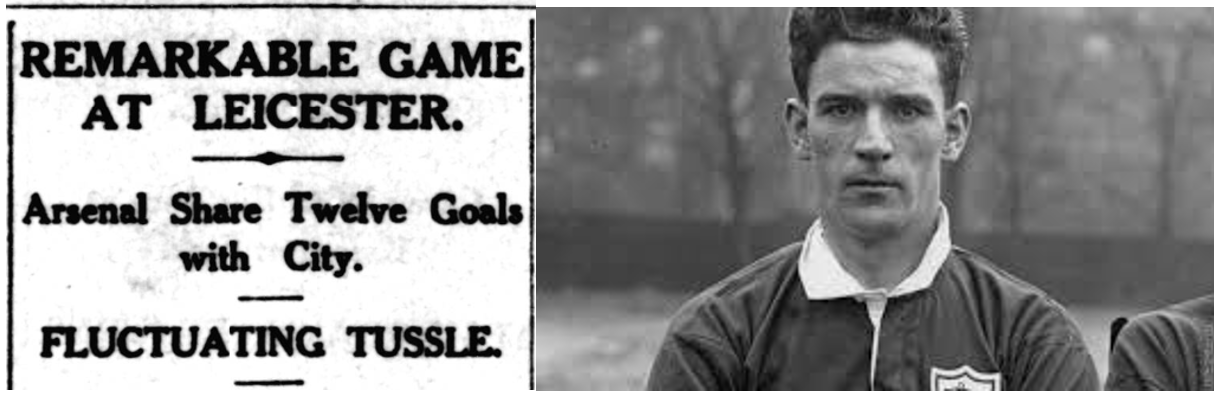
On April 21, 1930, at Leicester City’s old Filbert Street ground, an incredible game of football took place that still holds a record nearly a century later: the highest-scoring draw in English top-flight history. It wasn’t just the scoreline that was shocking; it was the story of the untested hero, the absent stars, and the game’s ultimate architect, Herbert Chapman, whose relentless pursuit of success dictated the entire bizarre affair.
The most consequential factor leading to this 6-6 draw was the vision of Arsenal manager Herbert Chapman. Chapman is widely regarded as the first truly modern manager in English football. His impact extended far beyond just winning trophies; he fundamentally transformed the way the game was managed, prepared for, and played.
Chapman’s innovations included: the famous W-M formation , which he pioneered to adapt to the offside rule change of 1925, creating a solid defensive unit while allowing quick counter-attacks. He also introduced scientific training methods, insisted on physiotherapy for players, introduced squad numbers and white sleeves on the Arsenal shirt, and successfully campaigned for the renaming of the local Underground station to “Arsenal.” His decision to bench his entire first team for the Leicester game was a pragmatic masterstroke, prioritizing the FA Cup Final—which he saw as a defining step for the club’s prestige—over a meaningless league fixture. This ruthless focus on defining moments, rather than mere accumulation of points, was central to his modern approach.
The match against Leicester City was played against a defining backdrop of Arsenal’s overwhelming FA Cup ambition and Leicester City’s secure, if ordinary, league standing. With the FA Cup Final against Huddersfield Town looming on April 26th, Arsenal manager Herbert Chapman—known for his revolutionary focus on preparation—made the critical decision to rest virtually his entire first-choice squad. Prioritising the health and freshness of his stars for the final, he sent a severely depleted, largely reserve team to face Leicester. In contrast, Leicester City had enjoyed a respectable, if unremarkable, campaign in the First Division, comfortably securing their top-flight status for another year, meaning they had little other than pride to play for.
The teams were:
Leicester City: Joseph Wright, Adam Black, John Brown, Albert Harrison, Norman Watson, Len Barry, Hugh Adcock, Arthur Chandler, John Duncan, Ernest Hine, Arthur Lochhead.
Arsenal: Dan Lewis, Tom Parker, Horace Cope, Alfred Edward Haynes, Bob John, Cliff Bastin, Joe Hulme, Dave Halliday, David Jack, Alex James, Alf Baker.
The Aftermath: A Hero’s Heartbreak and Career
The fortunes of the game fluctuated to an extraordinary extent, Arsenal scored first, but Leicester held a 3-1 interval lead. Later, Arsenal led at 5-3 and 6-4, only to lose their advantage ere the end. Early in the game Jack netted for Arsenal, but the point was disallowed for offside. Then Halliday scored for the visitors: Adcock equalised; Lochhead gave Leicester the lead and, from an oblique angle, Adcock scored the third goal. Early in the second half Arsenal scored three times in ten minutes. Bastin getting the first of them and Halliday the other two. Subsequently Halliday scored Arsenal’s fifth goal, and Hine got Leicester’s fourth. Bastin put on the sixth for the Arsenal and Barry and Chandler got the fifth and sixth for Leicester. The final whistle sealed the score at an astonishing 6–6. The 12 goals scored represented a shared record for the most goals in a single English top-flight fixture.
The Aftermath: A Hero’s Heartbreak and Career
Despite his incredible performance, the game proved to be David Halliday’s final appearance for Arsenal. Halliday was a prolific Scottish goalscorer who had been brought to Highbury from Sunderland, where he had been the top scorer in the English league in 1928-29 (scoring 43 goals). However, manager Herbert Chapman was never fully convinced he fit his tactical system. Halliday was simply a reserve player for this match; his four goals were not enough to displace the first-choice forward, Jack Lambert, who was rested. Arsenal went on to win the FA Cup final later that week. Halliday was transferred shortly after the season ended, making the 6-6 draw his final, sensational, yet ultimately tragic curtain call for the club.
Halliday’s career did not end there, however. He moved to Manchester City, where he continued his goal-scoring exploits for three seasons. He later went on to become a successful manager, most notably guiding Scottish club Aberdeen to their first-ever league title in 1955. Despite being one of the most prolific goalscorers of his era, the 6-6 draw remains the bizarre bookend to his brief and frustrating time at Arsenal. Arsenal played in the FA Cup final later in the same week. Despite his four goals Halliday was not selected for the game.[4] Arsenal went on to lift the trophy, defeating Huddersfield Town 2–0.[8] Halliday now had five goals from his last three Arsenal first team’s games. However, after the Leicester 6–6 draw he never played for Arsenal’s first team again.
David Halliday, is most significantly linked to Leicester City through his time as both a manager and a scout. His managerial tenure from 1955 to 1958 was highly successful, culminating in the club’s promotion to the top division of English football. Halliday guided the Foxes to the Football League Second Division title in the 1956–57 season “in style, breaking many Club records” along the way. During this period, he notably signed a strong core of Scottish players, which led to the team being affectionately nicknamed ‘Leicester Thistle’. Following his departure from the manager’s role in 1958, Halliday, who was born in Dumfries in 1901 and later died in Leicester in 1970, maintained his connection with the club by transitioning into a scout role, specifically covering the north east of Scotland.