
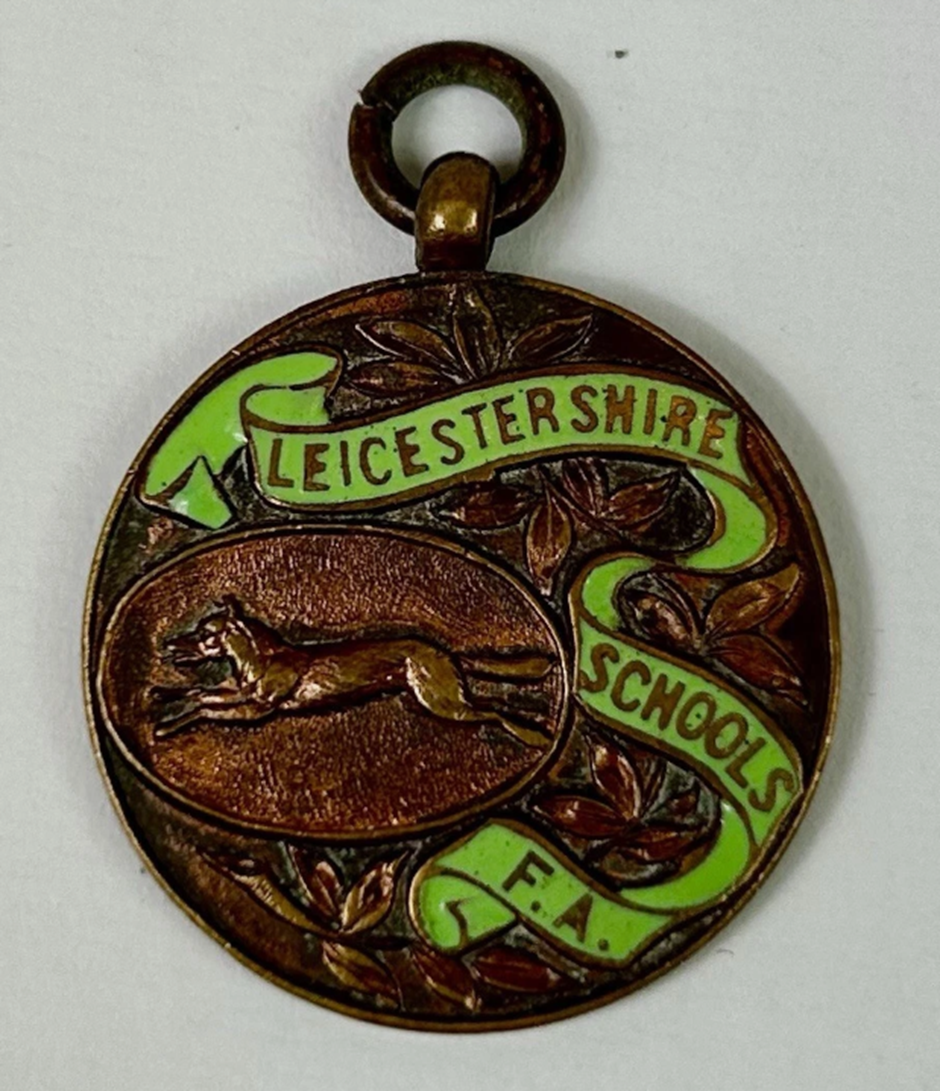
The story of the Leicestershire & Rutland Schools’ Football Association (LRSFA) is a remarkable chronicle of dedication. For over a century, teachers and volunteers have navigated financial crises, world wars, and changing social standards to ensure that the “beautiful game” remains a cornerstone of local education. Beyond the administrative history, the Association has served as a prolific nursery for professional talent, proving that the roots of England’s national game are firmly planted in the schoolyards of Leicestershire.
The Association was officially born on Saturday, October 8, 1921, at a meeting held at St. Luke’s School, Leicester. Under the leadership of the first Chairman, Mr. Goodacre (Melton Mowbray), and Secretary Mr. A.C. Robinson, the committee set out clear eligibility rules: any boy was eligible until the term following his 14th birthday, provided they were in actual attendance at school. The early years were defined by humble beginnings; 1,000 copies of the first handbook were printed for £8 and sold to pupils for 2d each. At the first AGM on June 24, 1922, the LRSFA affiliated with the English Schools FA. In 1924, noting that boys struggled to grasp the offside law, the AGM agreed to issue a special paper to all schools for players to “peruse.”
In February 1934, a meeting at the Leicester YMCA changed local history. The President, Montague John Rice, donated a silver bowl to serve as the Junior Schools Trophy. This “Rice Bowl” became the holy grail for local children. The passion was immense; one boy from Loughborough was reportedly so upset at being left out of the County selection that he decided to leave school entirely. It was in this era that icons like Sep Smith emerged. Smith, who played for Leicester schools shortly after the Association’s formation, became a Leicester City legend, making over 400 appearances.
The Junior Cup has seen several schools establish historic dynasties. Newbold Verdon holds the most remarkable record, winning the trophy five times in just six years (1956, 1957, 1959, 1960, and 1961). Newry Junior School achieved the first “hat-trick” of three consecutive wins (1951–1953), featuring a young Graham Cross, who would later play 599 games for Leicester City. In more recent decades, Alderman Richard Hallam has emerged as a modern giant, taking the trophy home in 1996, 2005, 2011, and 2015. Other perennial powerhouses include Overdale (winners in 1964, 1968, 1989, and 2006) and Whitehall, who dominated through the 60s and 70s.
1939 AGM at Alderman Newton’s School was the last for years; the minutes weren’t signed again until 1946. Matches resumed with warnings of “clothing difficulties” due to rationing. Despite this, they expanded to three competitions: a Senior Cup, an Intermediate Cup (U14), and the Junior “Rice Bowl” (U11). In 1949, Leicester City FC began donating 300 tickets for every home game at Filbert Street. This era nurtured legends like Peter Shilton, who followed the path paved by local schoolboy competition into the England record books.
In November 1972, controversy struck Market Harborough when a girl played for her primary school team—an action the school was reminded was “contrary to rules” at the time. However, this sparked a long evolution. Today, girls’ football is at the heart of the LRSFA. The county is now a powerhouse for female talent, with schools providing a vital pathway into the professional women’s game through dedicated girls’ brackets for all major trophies.
The quality of play reached a historic peak in 1979/80 when Norman Leet of Guthlaxton College captained both the Leicestershire County team and the England Schoolboys. Leet went on to play professionally for Leicester City in the First Division, proving the “Step Ladder” from school pitch to top-flight was possible. The pipeline continued with Emile Heskey, Dion Dublin, and more recently, Harvey Barnes, who competed in LRSFA competitions at Greenfield Primary.
Modern Era: Current Competitions Today, the LRSFA manages a massive calendar under the “Team Leicestershire” banner. The modern structure ensures every student has a chance to compete, culminating in high-profile finals at venues like the King Power Stadium or the LCFC Seagrave Training Ground.
- Primary (U10-U11): The Mixed Rice Bowl, The Girls’ Rice Bowl, The Philpott Cup, and the Small Schools’ Cup.
- Secondary (U12-U16): Boys and Girls County Cups for every year group (Years 7–11), including the historic Intermediate Cup (Year 9) and the Senior Cup (Year 11).
- College/Sixth Form (U19): The U19 County Schools’ Cup and Trophy.
- Representative Football: County-wide “all-star” squads at U14, U16, and U18 levels.
Whether it is a rural village school competing for the Small Schools’ Cup or a city powerhouse chasing the original 1934 silver Rice Bowl, the legacy of the 1921 founders continues to inspire the next generation of Leicestershire stars.