
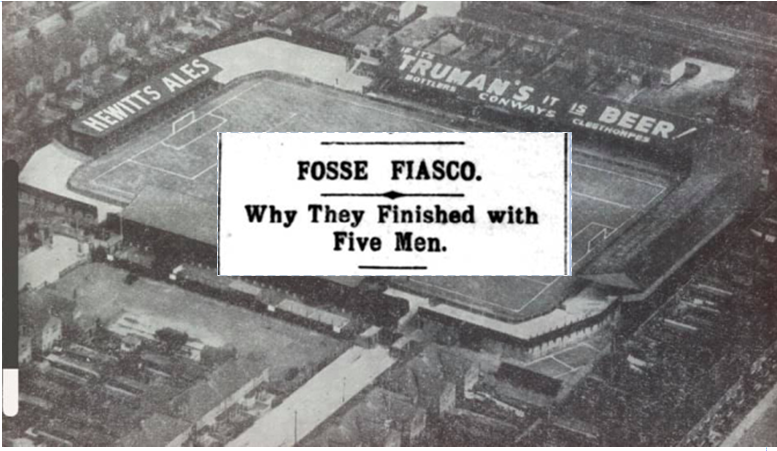
Satirday 6 January 1912, wasn’t just another away fixture for Leicester Fosse; it was a day etched into the club’s history as a harrowing, almost unbelievable ordeal. Their visit to Grimsby that day wasn’t just a 4-0 loss; it was a footballing nightmare that saw them finish the match with only five players on the field. The sheer “wretched conditions” under which the game was allowed to proceed left even the most seasoned enthusiasts dumbfounded.
The pitch itself was an absolute disgrace, nothing less than a “huge mud heap” riddled with pools of water that turned tackles into undesirable mud-baths. Crucially, the field markings were mostly obliterated, making accurate decisions from the referee and linesmen a matter of pure guesswork. To top it off, one corner flag was virtually submerged in a small lake, making proper corner kicks impossible. As if the treacherous ground wasn’t enough, rain relentlessly “teemed down,” driven by a “bitterly cold, cutting wind”—a day “not fit to turn a dog out.”
The Referee’s Unyielding Stance
Given the appalling state of affairs at kick-off, many expected the game wouldn’t even start, let alone finish. However, referee Mr. Adams of Nottingham had other ideas. Despite repeated appeals from Fosse captain Hubbard and numerous conferences involving officials and players, Mr. Adams remained steadfast, ordering play to continue to the “bitter end.” He got his wish, but the chaotic sequel that followed was truly unique in football history.
Within the last ten minutes of the game six Fosse players— Tommy Clay, Bob Thompson, Percy Hanger, Edwin King, Frank Rollinson, and Dick Allman—left the field due to extreme exhaustion and physical collapse. This left Leicester Fosse with an astonishingly depleted five men to see out the remaining minutes.
The crowd’s reaction was predictably hostile, as they felt the Fosse players should have endured the elements like the home side, Grimsby Town. Yet, this comparison was hardly fair. Conditions had worsened dramatically in the second half, with Fosse battling against the wind and heavy rain. Moreover, Grimsby’s players were older, more experienced, heavier, and possessed greater stamina. Crucially, the “Fishermen” also had the advantage of “thick sweaters underneath their shirts,” while the young Fosse players were clad only in thin blue jerseys.
It was no surprise that the Fosse youngsters were utterly spent. They were simply unable to continue. Tommy Clay, in particular, suffered a “most serious collapse” in the dressing room, requiring the urgent attention of both a trainer and an ambulance man to revive him. Three other players were plagued by body cramp, and Thompson’s eyes were so caked with mud he lost his sight.
The Aftermath and Penalties
Captain Shirley Hubbard’s persistent appeals to the referee to stop the game during the latter part of the second half were all dismissed Mr. Adams reported the incident to the authorities, leading to an inevitable inquiry. While some believed severe penalties would be inflicted, it was difficult to comprehend how players could be punished for being physically unable to continue due to sheer exhaustion—there truly is a limit to even a footballer’s endurance. As for the match itself, it was deemed unfair to criticize the play under such adverse circumstances, though it was noted that Fosse didn’t deserve to be a goal behind at halftime and Grimsby was “always top dog” in the second.
Ultimately, the Football Association took action. The Leicester Fosse players were each fined £5 for leaving the Grimsby enclosure before the match concluded without the referee’s permission. Furthermore, Fosse trainer Harley Thompson received a two-month suspension!