
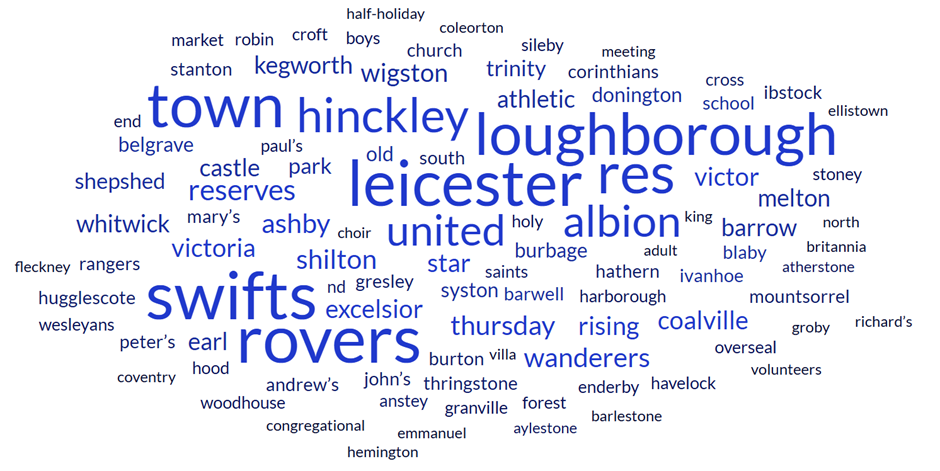
As we look out at the modern football landscape, it’s easy to take club names for granted. But cast your mind back to the 19th century, when the beautiful game was truly finding its feet, and you’ll discover that the names of early football clubs, especially right here in Leicestershire, tell a fascinating story about the times. Far from being random, these names were deeply embedded in the social, industrial, and geographical fabric of the era.
Let’s dig into the rich history behind the names of Leicestershire’s pioneering football clubs:
Rooted in Our Local Landscape: Geography and Identity
One of the most straightforward ways clubs got their names was by simply adopting that of their town or village. It was a direct, clear statement of allegiance and community representation. Think of familiar Leicestershire examples that perfectly illustrate this: Castle Donington, Loughborough, Market Harborough, Syston and Uppingham. These names immediately tell you where the club’s heart lay. In some cases, clubs even delved deeper into their local identity, taking names from specific streets, neighbourhoods, or districts within a town, further cementing their connection to their immediate surroundings. Examples: Coalville East End, Hinckley North End, Leicester London-road, Northgate, Sanvey-Gate, and Saxe-Coburg-street.
Born from Our Institutions, Schools, and Landmarks
The Victorian era in Leicestershire was a time of booming industry, and football was no stranger to the factory floor. Many early clubs were in fact works teams, formed by employees from specific industries or factories. This wasn’t just about sport; it was about fostering camaraderie and a sense of shared identity among workers. Examples: S Davis & Sons Ltd FC, Evans & Co FC [Melton], Falcon Works, Leicester Teachers, Morley’s Factory, Netherseal Colliery Perseverance Club, Quarry Workmen, Railway United and Whaite’s Tannery.
Beyond the workshops, the prevailing ideal of “Christian muscularity” in the 19th century encouraged young men to participate in physical activity. This meant that numerous clubs had their origins in churches and religious organisations, providing a structured outlet for sport and community engagement. Examples: Hugglescote St John’s, King Richard’s-road Wesleyans, Leicester St Mary’s Swifts, YMCA, Whitwick White Cross.
Football clubs are often named after more than just their town; they frequently draw inspiration from local landmarks or significant historical figures tied to their area. This tradition grounds the club in its community’s unique identity and heritage. For example, Ashby Ivanhoe takes its name from the historical novel Ivanhoe by Sir Walter Scott, set in the Ashby de la Zouch area. Enderby Granite highlighted the prominent granite quarrying industry in Enderby. Hugglescote Robin Hood nods to the legendary outlaw often associated with the wider Leicestershire region. Leicester Fosse refers to the Fosse Way, an ancient Roman road that runs through Leicester, indicating the club’s deep historical roots in the city. Finally, Mountsorrel Castle directly references the historic castle in Mountsorrel, linking the club to a significant local landmark.
It’s also worth remembering that football didn’t just appear out of nowhere. A significant number of early football clubs in our county, and across England, emerged from existing athletic and cricket clubs. Examples: Leicester Athletic Society FC, Loughborough Athletic & Football Club [aka Loughborough Town], Lutterworth FC, Market Harborough FC, and Temperance Cricket Club. Looking for a winter sport to keep their players fit and active during the off-season, these cricket clubs seamlessly transitioned into football, often forming the bedrock of today’s established teams. While less prevalent in Leicestershire, it’s also true that public schools and universities elsewhere, like the Old Etonians and Old Carthusians, played a crucial role in developing the game, directly influencing some club names. Examples: Hinckley Grammar School Old Boys, Loughborough Adult School, Loughborough Grammar School, Mill Hill House School, Wyggeston School.
Names with Aspirations and Descriptions
Beyond geographical ties and institutional roots, many club names carried broader meanings, reflecting the club’s nature or its ambitions:
- “Albion”: is an archaic and poetic name for Great Britain or England. Examples, Anstey Albion, Groby Albion, Ibstock Albion, Shepshed Albion, and Whitwick Albion
- “Athletic”: This term was a popular addition, often used to distinguish football clubs from other sports as the game became more organised and competitive. It underscored the physical and sporting prowess of the club. Examples: Coalville Athletic, Hinckley Athletic, Leicester Athletic, and Loughborough Athletic.
- “Excelsior”: A Latin word meaning “ever upward” or “higher,” this was a choice full of optimism and ambition, reflecting a club’s drive for continuous improvement and success. Examples: Barrow Excelsior, Earl Shilton Excelsior, Leicester Excelsior and Syston Excelsior
- “Rising Star”: This descriptive name generally implied a club that was newly formed or quickly developing, suggesting a fresh start and a strong desire to achieve great things in the footballing world. Examples: Barrow Rising Star, Croft Rising Star, Ravenstone Rising Star, and Seagrave Rising Star.
- “Rovers” / “Wanderers”: These evocative names were often adopted by teams that didn’t have a permanent home ground and quite literally “roamed” from one pitch to another. Rovers was often used to denote the second or reserve team of a well-established club. The term “Wanderers” also conveyed a more romantic notion of gentlemen playing for the sheer enjoyment of the game. Examples: Bagworth Rovers, Fosse Rovers, Melton Rovers, Oakham Rovers, Shepshed Rovers, and Wigston Rovers; Denton Wanderers, Coleorton Wanderers , Ellistown Wanderers, Hinckley Wanderers, Measham Wanderers, and Thursday Wanderers.
- “Town” –simply and directly signifies that the club represents the town in which it is based. Often, these clubs were considered the main or “town” club for their respective areas, distinguishing them from smaller, more localised teams within the same vicinity. Examples: Anstey Town. Ashby Town, Hinckley Town, Leicester Town, and Uppingham Town
- “Trinity”: almost always indicates the club’s formation or close association with a Holy Trinity Church. Examples: Ashby Trinity, Barrow Trinity, Hinckley Trinity and Loughborough Trinity.
- “United”: This powerful term frequently signified the unification of a local community behind its team, or, more literally, the merger of, two previously separate clubs coming together. Examples: Aylestone United, Ashby United, Belgrave United, Burbage United, Coalville United and Thringstone United
- “Victor / Victory / Victoria”: In an era dominated by Queen Victoria’s reign, these names often served as a homage to the monarch, reflecting patriotic sentiment and a natural desire for triumph on the pitch. Examples: Oxford Victoria, Peggs Green Victoria, Leicester Victor, St Paul’s Victor, and Sileby Victoria.
So, the next time you hear a Leicestershire football club’s name, take a moment to appreciate the history woven into its very fabric. These names are not just labels; they may have enduring echoes of the past, telling a rich story of local pride, industrial spirit, and the burgeoning passion for football in our county.