
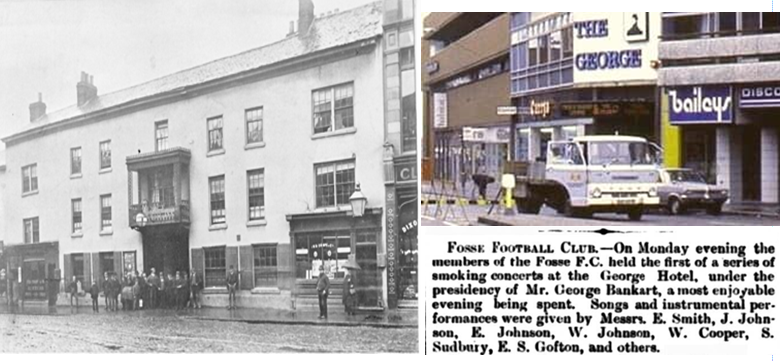
In November 1887, Leicester Fosse, the town’s burgeoning football club, held a significant event at the historic George Hotel in the Haymarket. This wasn’t merely a social gathering; it was the club’s inaugural Smoking Concert, a public statement of their increasing prominence in Leicester’s sporting scene. Interestingly, the George Hotel also played a role in the history of another prominent Leicester sports club. In August 1880, Leicester Football Club (Tigers) was formed there through the merger of three local clubs: Leicester Societies AFC, Leicester Amateur FC, and Leicester Alert. Just twelve weeks later, on October 2nd, they played their very first match against Moseley. In the spring of 1887, the meeting which led to the formation of the Leicestershire Football Association also took place at the George.
The George Hotel, or “The George” as it was affectionately known, was no ordinary inn. Its lineage stretched back to at least 1580, perhaps even as far as 1458. The building standing in 1887 was a grand Georgian structure, erected around 1799, which replaced an earlier incarnation. It served as a vital coaching inn, a bustling hub where the “Defiance” horse-drawn coach would depart daily, a remarkable feat at the time, reaching London on the same day. Its passageway even featured a unique wooden turntable to manoeuvre coaches in its narrow yard, a testament to its forward-thinking design.
Through the 19th century, under a succession of licensees like the Briggs family, Ann Marion Marston, and later William Lewis Fuller, The George adapted to the changing times. In the 1840s, it even housed the Midland Counties Railway’s Parcel Department, offering collection and delivery services, alongside an omnibus and fly to ferry passengers to and from the railway station. By the turn of the century, The George was owned by Ind Coope Brewery, cementing its place as a significant watering hole and social venue.
Smoking concerts, a quintessentially Victorian phenomenon, were exclusively male affairs. They offered a rare opportunity for gentlemen to relax, smoke pipes and cigars freely, and indulge in an evening of live music and entertainment. These weren’t always polished, professional performances; often, local talents would take to the stage with songs, instrumental pieces, sketches, or recitations. The atmosphere was one of convivial camaraderie, hearty laughter, and robust discussion – a stark contrast to the more formal social engagements of the era.
For Leicester Fosse, the Smoking Concert at The George was more than just an evening of entertainment. It was a strategic move, designed to build cohesion within the team, cultivate a strong relationship with their growing fanbase, and no doubt, to drum up vital support and funds for the club’s ambitions. One can easily imagine the scene: the clinking of glasses, the murmur of conversation punctuated by bursts of applause, and the aromatic haze of tobacco smoke filling the grand rooms of The George, as tales of heroic tackles and daring goals were recounted with gusto.
The very choice of The George spoke volumes. It was a place of standing, a known meeting point for various clubs and associations, from political parties to the Leicester Bicycle Club. For Fosse to host their inaugural event here was to firmly stake their claim within Leicester’s social fabric, aligning themselves with a landmark that embodied stability and tradition.
The George’s story continued long after Fosse’s celebrated evening. Around 1890, the Georgian edifice was replaced by a magnificent Victorian Gothic structure, a testament to the era’s architectural aspirations. This iteration of The George witnessed its own share of drama, including fines during WWI for prohibited hour sales and an infamous 1931 raid on its vaults for illegal betting. Despite changes in ownership, including Bass Ratcliffe & Gretton Brewery, The George remained a beloved institution.
However, the march of progress eventually caught up with even this resilient landmark. The 1960s saw the magnificent Victorian Gothic George demolished to make way for the new Haymarket shopping centre. A modern, less aesthetically pleasing “new” George emerged in 1968, which, while popular with the younger set, could never truly replace its grand predecessor. Yet, even this iteration had its moments, sitting adjacent to popular nightclubs like Baileys in the 70s and 80s, before undergoing various transformations into venues like Topps, Rickshaws, Red Room, Crypt, Tower Gate, Zeus, Niche, and Ice.
But on that November night in 1887, none of that future was known. The George Hotel, in all its Victorian splendour, provided the perfect backdrop for Leicester Fosse to gather, celebrate, and lay the foundations for what would become a significant part of Leicester’s sporting heritage. The echoes of their camaraderie, and the distinctive aroma of that first smoking concert, undoubtedly lingered in the historic air of the Haymarket, a testament to a club taking its first bold steps into the public eye.