
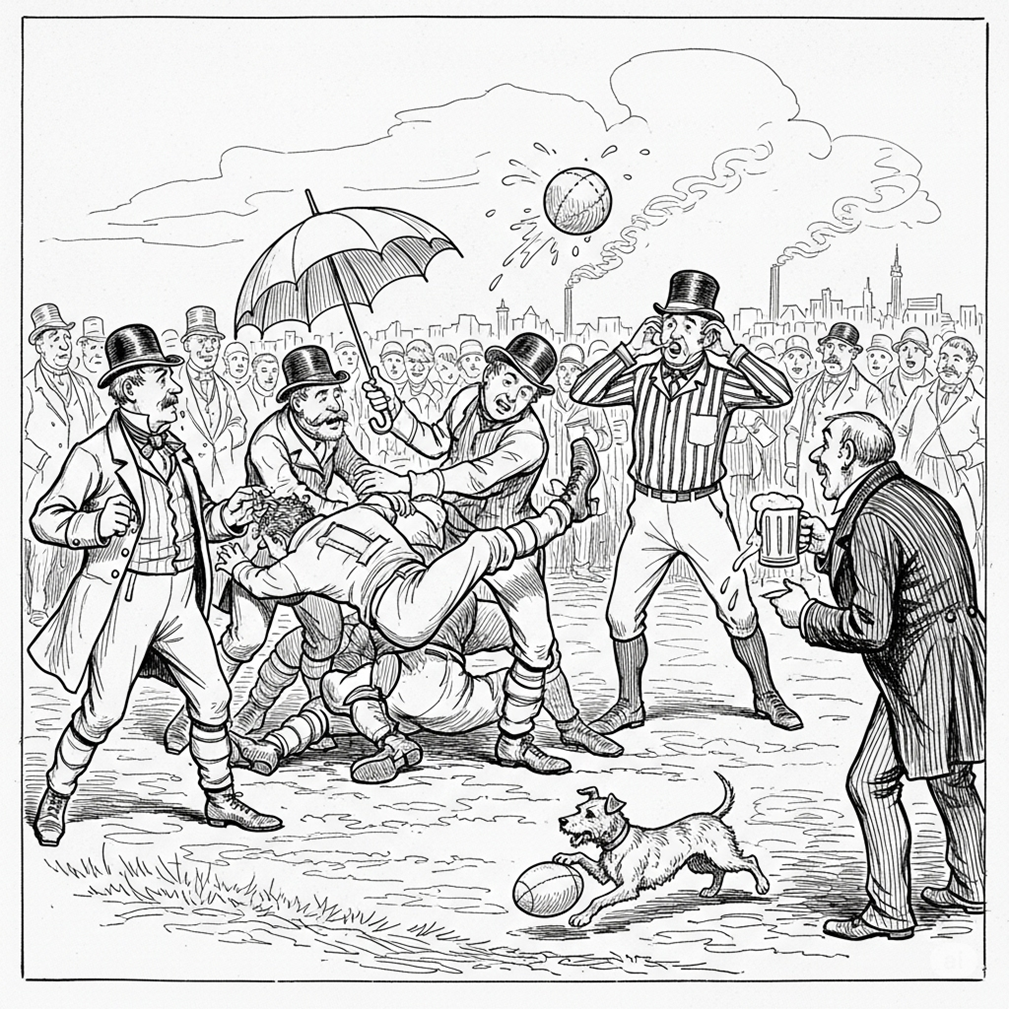

There are doubtless a good many people who are ready to declare that there is no humorous side in football. Club financiers who every year have to juggle with and make the best of adverse balances, ranging anywhere between £500 and £I,000 — and there are a good many who are set this gloomy task — may well ask where the humour comes in. But there is plenty to be found all the same, and if the light side of the game has presented itself more prominently to myself than to others, then I can only urge that the varied experience I have enjoyed in the sport is, perhaps, responsible for my being so specially favoured. The introduction of professionalism brought in its wake a number of evils and abuses, which the Football Association immediately set about to destroy, and in this work it has certainly eliminated a good many things which were by no means a credit to the game. Possibly the use of a registration form upon which it was possible for a club to sign a player for more than one season was responsible for many humorous situations. Players who desired to play with a club for one year only were surprised to find that they had almost signed their football death warrant, and the fact that the forms were the same for each season enabled a club secretary to secure such a supply as would make it easy for him to fix up a good many players for a long period. The Association stopped this by
THE VERY UNIQUE DEVICE OF HAVING NEW FORMS FOR EACH SEASON,
the distinction being that a different coloured line running from top to bottom of the sheet of printed foolscap is now used every year. I remember a player being brought up before a County Association for what is always a very terrible offence, namely, appending his signature to two forms for two different clubs. He stoutly denied his guilt. He was asked if the form he had signed was one with a red or blue streak down the centre. Thinking he would be right if he named the colour of the previous season he did so. That marked the downfall of that young man, for instead of its being red the colour had been changed to blue that season. So he was suspended from taking any part in the game for a season. Such, alas! are the methods by which the slippery “pro” is caught. When professionalism first came along clubs were very much taken up with Scotchmen, and any player possessing the prefix of “Mac” was immediately pounced upon. I well remember several instances in which clubs were imposed upon by mere tramps, who canvassed committeemen during the day, in the opening month for practice, and having by the exhibition of an old pair of football boots enticed a subscription from several of these football enthusiasts, and an urgent committee meeting to sign them without delay, were missing altogether in the later hours of the day. Writing of the Scotch element in English football, I shall not readily forget an attempt to sign a Scotchman in East Stirlingshire a few years ago. The way in which the natives of any football village of importance over the Border can detect an individual bent upon a poaching expedition can only be realised by those who have been engaged in the work. I had not been in the place more than half-an-hour before I was followed down the street by a far too attentive crowd, whose remarks, to say the least, could hardly be described as Parliamentary. But I flattered myself that only one inhabitant knew whom I wanted, and he was engaged in a cricket match. I knew better than attempt to approach such a place and, taking the bull by the horns, I visited the hostelry where I knew he would be likely to look in. Having not only refreshed myself, but also everyone who would consent to be victimised by my strategy, I waited. My man came at last, in his cricketing flannels, flushed with having made a big score. At his approach I left the room, and wished the company a good evening.
THE FLY CAME INTO MY PARLOUR ALL RIGHT
a few minutes later, and we soon fixed up terms, and exchanged a crisp five-pound note. I laughed heartily when the crowd gave me another taste of their displeasure on reaching the open air, but I had travelled three hundred miles and had the coveted signature. Still, I would not care to do it again. But it is one thing to sign your man and another to bring him to the mark, as a good many clubs know. My first experience of this was singularly amusing. In my native town, whilst fulfilling the duties of secretary and general club manager many years ago, I created some considerable consternation by securing the signature of a very clever goalkeeper who played for the great rival club in the same town. It was a bold stroke, and there were a good many who urged that though I had got Tompkins’s (that wasn’t his name, but it will serve) signature, to get him between the sticks was quite another thing. Personally, I knew this, from the character of the man, but that only assisted me to make my plans accordingly. The season drew near. Tompkins, who had been engaged in another sphere of sport in a distant part of the country, appeared not. This I was prepared for and had intimated that as I knew he would be in good condition, if he arrived the night previous to the first match, it would be all right. In the meantime the football enthusiasts in the town were at fever heat, and I am sorry to say that, though there is very little of the gambling element nowadays in football, on this particular occasion there was a great deal. “Tompkins plays to-morrow,” said one section. “He’ll never play for the Vampires,” stoutly declared the other party. At five o’clock Tompkins arrived. I knew it, and I also knew that someone had met him at the station, and that this busy individual was no friend of the Vampires. We exchanged courtesies, and then Tompkins remarked : “I shall not play to-morrow.” He was particularly cool in making the announcement. I was also fairly composed, I believe, in receiving the intimation. “Oh!” I remarked. “Why?” “Oh! for nothing particular,” he said, “only I shan’t turn out to-morrow.” I did not argue the point at all. I merely reminded him that I had his signature, that he could play for no other club, and that if he did not turn out on the following day I should treat it as misconduct and suspend him for the whole of the season; which I knew would be a serious matter for him, for he was receiving what in those days was a really princely salary. Oh ! the excitement in that little town that evening. The next morning, the day of the match.
TOMPKINS TRIED A NEW MOVE.
He was very ill! He sent his mother to me to intimate the fact that it was impossible for him to get out of bed, much less play football. Now, I do not think I am a very hard-hearted individual, but I felt certain it was a “put; up job,” and I sent a message back that if Tompkins was not ready to take his place by a quarter of an hour before the time for kicking off he would not play football for that season. I need only add that Tompkins turned up, and, to his credit be it said, he played a brilliant game and behaved himself right through the season. It is not, perhaps, a nice thing to say, but professional players are frequently the most careless and untidy individuals to be met with in a day ‘a march. Some players refuse to even lace their own shoes. Before trainers were so generally employed the last thing the players thought of was their playing outfits. A well-known team arrived in one of the Lincolnshire towns a few years ago without either football shirts, knickers, or boots, and the picture they presented when finally fitted out by the local trainer was one to be remembered. They returned the kindness of their opponents by actually winning the game, though they had been playing in tennis shoes, navvies’ boots, and cricketing shoes. This was the unkindest cut of all. I well remember, too, taking a team into the Black Country, when upon arriving it was found that none of the men had knickers. It was no use lecturing them then upon the want of thoughtfulness on their part, so I hurried off and bought a dozen pairs. I need not dwell more upon this incident then to say that five of the men were absent from the field when “Time” was called. Football is very much impressed upon the travelling public on Saturday afternoons, and In some districts especially some where the juniors make the air hideous by their anticipations of victory, and later on their somewhat pronounced expressions consequent upon the realisation of their hopes. The Leen valley, in the Nottingham district, was a hotbed of football once, and probably is now, and the one o’clock train from the county town to Mansfield, stopping at all stations, is worth patronising, if only to see what goes on in the junior football world, so far as that part of it is concerned. Quite oblivious that the train is not run entirely for their benefit, it has been christened the “Football Mail,” and as there are about a dozen teams picked up before it reaches its destination, it can easily be imagined that one does not travel very comfortably. The first intimation of what is coming is probably the tossing into the carriage of half-a-dozen pairs of dirty boots, which, with the proverbial untidiness alluded to, bear unmistakable signs of the previous Saturday’s contest. Then there is a struggle on the part of half a dozen to get their heads out of the window, and discuss the game with their neighbours in the next carriage. Once the market women used to convey their baskets of eggs and butter by the “Football Mail,” but they learnt experience from the first journey. Writing of travelling, though, a good many humorous stories could be given, and as in some four seasons I travelled over 6,000 miles, my thoughts go back over a good many incidents. And let me here say that there is nothing so handicaps a team as a long journey, nothing that acts so adversely to men as to be penned up in a railway saloon, no matter how comfortable, for some six or seven hours before a match. I must be content to give but one extract from my football reminiscences in the matter of railway travelling, but surely one that is quite unique. My team was visiting a Staffordshire town — which, for obvious reasons, I dare not mention — bent upon playing an exhibition game. The ground ran alongside the station, and one had only to run down a set of wooden steps to get on to the field of play. The trains were, unfortunately, very few and far between, and it was imperative that we should return by that leaving at five o’clock,
OR ELSE BE STRANDED FOR THE NIGHT.
So it was decided that the game should be stopped ten minutes before the arrival of the train, which, of course, could be seen from the ground. Now, it must, be said here that the station-master of the little town was a most ardent soul, and full of enthusiasm for the game, and had from the time of our arrival taken a very great interest in our players. As a matter of fact, he went so far as to say that it would be a great pity to come such a distance and go back beaten. Any way, he was one of our best supporters that afternoon. It was arranged that, as the station-master knew the signals, and would be able to tell when the train was coming in, he should be permitted in the second half to stand inside the ropes and near the centre line, and to wave his hat to the referee to stop the game as soon as the train was due. The contest proved a most exciting one. Twice we had equalised, and then, losing the lead again, defeat seemed certain. The station-master had clearly lost all thought of the train in his wild gesticulations, and his repeated calls to our men to make one effort and pull the game out of the fire. In came the train, with our men storming their opponents’ goal. The guard was no football enthusiast, I am sorry to say, and his language was exceedingly free as he shouted to the station-master to let the train go. Then this august president of the entire railway plant of the neighbourhood remembered his duty, and, with an alarmed expression of surprise at seeing the train in the station and the guard waving his hand from the platform, he gave the promised signal. The referee blew his whistle, and we romped off the field and dived into the saloon. Here we found that some kind friend had conveyed the players’ ordinary clothes to the carriage, and the next minute the train was whizzing us back home again, after one of the most amusing experiences that could fall to the lot of anyone. Football officials have doubtless met with quite as many humorous incidents as myself, and could tell of not a few diverting situations. I well remember, whilst acting as secretary of one of the League clubs, being asked to officiate as referee in one of the Lincolnshire towns. The two local teams were playing, and the entire place was given over to the game. A general half-holiday was proclaimed, the schools closed for the afternoon, and flags and favours were displayed on every side. On arriving at the station the secretary of one of the clubs met me and pointed out that it was life or death with his club that day. If their rivals, the Wanderers, won, then they had decided to put up the shutters, sell the goal-posts, and never play again. I tried to show him how weak-minded such a course would be, but he said that the committee had fully agreed to take these steps if they lost. But they had also passed a resolution, which was to be communicated to me immediately on my arrival, that if they won my club was to be played a benefit match. Now, as a benefit match with the winners of this local championship would possibly have just met the expenses of printing and bill-posting, I was not greatly impressed with the offer, but I, of course, thanked his club, though it struck me as bordering pretty closely on a bribe. Half an hour later I was handed a note, which I found to be from the secretary of the Wanderers, asking me to meet him at the chief hotel. I did so, when he informed me that his committee had decided to play my club a benefit match, if they won that afternoon. The game, I believe, ended in a draw, and it is significant that I was not asked to officiate in the re-played match. I very well remember a referee in a South Lincolnshire match taking a most unusual course, and one which I should hope stands alone. The official has, I may just add, since filled an important municipal position in my native town; none other, indeed, than that of chief magistrate. He was asked to referee in a very important Cup tie,
WHEN THERE WERE NO GOAL-NETS IN EXISTENCE.
A terrific shot was sent in, and no one could exactly say whether it had gone between the posts or outside. The umpires, it is unnecessary to add, differed absolutely, one contending that it went three yards wide, and the other that there was no doubt whatever that the bail went through. The referee then tock an extraordinary course, as, ordering the players away from him, he quickly took a coin from his pocket, spun it up about 2ft. in front of him, and, catching it on the back of his hand, at once gave a goal. He had tossed for if! But I don’t believe there were many who saw him perform this extraordinary feat. One of our most respected referees once had an amusing experience at Newcastle. I noticed that upon testing the nets he appeared to hold on to the top rigging somewhat longer than usual. It appeared afterward, that he had got caught in the meshes, and could not move for some few moments, and was dangling with his toes just touching the ground! Some of the League grounds are in a shocking state in bad weather, and I shall never forget refereeing at Walsall on their old enclosure in West Bromwich-road, immediately after the ground had been re-laid. Not being of very gigantic proportions, I once found myself stuck fast in the mud, and it was only a wonder that I had not to stop the game and ask someone to pull me out. On the same ground, too, I remember well being knocked down with the ball and partly stunned; but I had the sense to blow the whistle whilst lying on my back and so prevent the game going on whilst I was in this undignified position. The foregoing will surely convince people that even though we have come to take the game rather seriously, there are reliefs to the strong business and commercial air which now permeates the national winter pastime. Most certainly for my part I decline to accept the French writer’s opinion that we take our pleasures sadly.
But one cannot expect to lay down a full code of rules in such a short article as this. I would, however, appeal to all those who have the football under their control at the bigger schools to
SPEND MORE TIME TEACHING THE BOYS THE PRINCIPLES OF THE GAME,
and to pay more attention to the lower games, and to the juniors, who are so often neglected. Football has quite as much to do with the physical education of youth as cricket has and is worthy of no less respect. Whatever may be our opinion on football for men, there can be no two opinions as to its absolute excellence for boys. Let it be treated as such.
We may, perhaps, with advantage try to compare the football of the schools we know. The best two schools in England are generally Bedford and Cheltenham, and perhaps their rivals in the north are Durham and Sedbergh. Now, these two latter schools have, for some years, tried conclusions with some of the Scotch schools, and, speaking from memory, I believe I am correct in stating that the results are about even. But were we to pick our four best schools to play Fettes, Loretto, Academy and Merchiston, I think the balance would generally be with the Scotchmen. I have seen many of the schools play, and can unhesitatingly say that Bedford, about ’92, was the best school team I ever played against.
Leicester Chronicle – Saturday 14 October 1899