
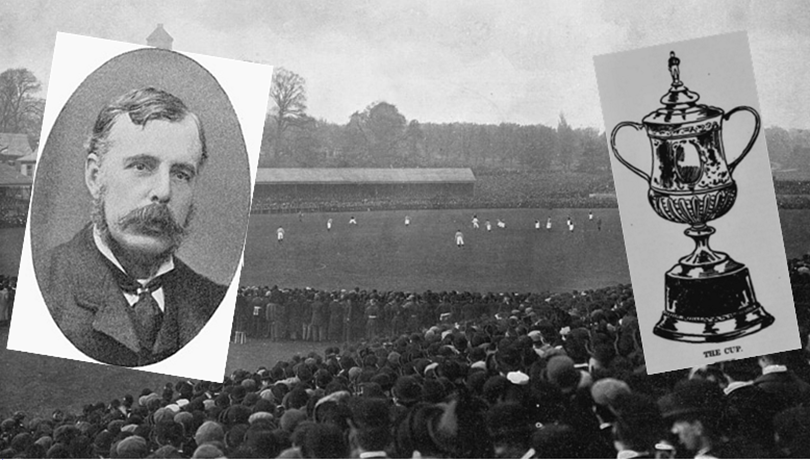
A quarter of a century ago modern football was only just commencing to assert its claim to a recognised place in the list of British sports. Forty years back the game itself was practically unknown. At first the mere holiday recreation of a few public schoolboys, the winter of 1859 had seen the formation of the first real football club— at least of one conducted on a proper basis. But it was the establishment of the Football Association Challenge Cup which brought the Association game to the front at a bound. How little the fathers of Association football, who met together on Ludgate-hill in the autumn of 1871, could have foreseen the remarkable impetus the competition they were arranging was to give to the development of football ! There was little, too, of bold advertisement about their methods, be it added. Only eleven clubs were represented at the inaugural meeting, and all of these were located within the Metropolitan radius, bar two. The modest sum required to purchase the trophy was subscribed by the clubs there and then, and on December 16th, 1871,
THE FOOTBALL ASSOCIATION CHALLENGE CUP BECAME AN ACCOMPLISHED FACT.
By that time most of the clubs had arranged their fixtures for the winter, so that the entries for the season of 1871-2 were comparatively small. Of the sixteen clubs competing the first year, only two came from the North. Donington Grammar School was one, the other was destined to play a very important part in the development of Association football — the celebrated Queen’s Park Club of Glasgow. At the outset distant teams were excused the early ties, and it was not until the fourth round of the first competition that Queen’s Park appeared actively on the scene. Good sportsmen as they have always been,’ the Scotch team came all the way to London in due course to meet the Wanderers. It was the first match of purely international character, and the Scotchmen made a splendid fight of if, though the Wanderers made a sad mistake in missing an easy goal just before the finish. Even then the drawn game was practically a loss to Queen’s Park, who were unable to stay in London to play it off, and had consequently to scratch. In the end the Wanderers and Royal Engineers were left to struggle for the possession of the Cup, which fell into the hands of the Wanderers after a one-sided game, though only by one goal to none. Just then the Wanderers, who had a monopoly of the best public school players of the day, could hardly do wrong.
THEY WERE CUP-FIGHTERS PAR EXCELLENCE,
as their brilliant record in those early days will show. Twice in succession, it is true, they failed to retain the Cup, which they had landed in 1871 as well as 1872. All the same, they made up for this double failure by a triple first in 1876 and two following seasons. In those primeval days three consecutive wins entitled the successful club to the absolute possession of the Cup. The Wanderers were the first and, as it happened, the only team to establish their claim. They won it altogether five times in the first seven years. It never passed into their hands, for the simple reason that, like good sportsmen, they handed it back to the Football Association, merely stipulating that it should never, in the future, be won outright. Curiously enough, they were never destined to reach the final tie again. The whirling of time was bringing its revenges — in fact, had been for some little time. Throughout the ‘seventies the competition had been a happy hunting-ground for Southern clubs mainly. It was not until the ‘eighties had begun that the North was represented. The final tie of 1881-2
COMMENCED A NEW ERA IN THE HISTORY OF THB CUP.
What a sensation, too, was caused by the first appearance of the Blackburn Rovers at the Oval that year! They came up confident enough, with a congratulatory poem in praise of their victory already printed. But, as they found to their cost, they had underrated the powers of the Old Etonians, who were their opponents. A powerful as well as a fast side they were, the Etonians of that day, and superior physique gave them the victory after a hard game by the one goal of the match. Blackburn footballers, as luck would have it, were to be successful in the following spring aa well. This time it was the Blackburn Olympic team, whose long passing enabled them to beat the Old Etonians by two goals to one. The final of 1883 was memorable, if only for one reason — that it was the last on which a Southern club appeared in the closing match of the competition. By this time Association football bad established itself firmly in the North, as well as in the Midlands. Queen’s Park, Glasgow, too, had not as yet forsaken the Cup, and they came very near winning it in the spring of 1884, being only beaten by the Blackburn Rovers, at the second time of asking, by two goals to one. Twice again the Rovers were successful, rivalling the achievement of the Wanderers. It was a remarkable performance, that triple victory of the Blackburn team. So evidently thought the executive of the Football Association, for a silver shield was presented to the Rovers in commemoration of an exceptional performance. They were hard put to it on the occasion of their third victory. West Bromwich Albion, another team of Cup fighters, had drawn with them at the Oval, and were only beaten when the game was played a second time at Derby. The next season the Albion were equally unfortunate, and that year, for the first time, the Cup found a resting-place in the Birmingham district;. But it was Aston Villa who won, and the West Bromwich Albion, who had twice in succession been the runners up, had to wait till their third final, that of 1887-8, before they were able to land the Cup. Nor can one forget the
WONDERFUL PERFORMANCES OF PRESTON NORTH END
in the season of 1883-4. It was an exceptionally fine side which did duty for North End that winter. There was no one to withstand them, and the double first they won in the Championship of the League and the final of the Football Association Cup was only the fitting reward of a long sequence of successes. Just then Lancashire football was quite in the ascendant, and twice again in following seasons the Blackburn Rovers gained possession of the Cup. Since 1891 the balance of power has passed into the Midlands. Only twice, indeed, has a Lancashire team got into the final. The scene at the Fallowfield Ground, at Manchester, when the Wolverhampton Wanderers and Everton met in the spring of 1893, will not readily be forgotten. The huge crowd interfered to a great extent with the play, but the game was allowed to stand, and the Cup went to the Wolves by the one goal of the match. Another stoutly-contested final was that of 1895. The Oval, which had been the scene of so many Homeric contests under both codes, had just been closed for football, so that it was not available. Fortunately for the Association, a ground of even greater capacity was ready to hand in the sports arena at the Crystal Palace. The first final decided there was a success in every way. Birmingham supplied both teams in the old-time rivals, Aston Villa and West Bromwich Albion. The Villa had the good fortune to obtain a rather lucky goal almost immediately after the kick-off. That early score determined the result. The Albion, as the game went, were quit, as good as their opponents. But, though they worked hard to the bitter end, they were unable to recover the goal they had lost, and were beaten, after one of the most exciting finals ever witnessed. As luck would have it, Aston Villa were the last team to hold the original Cup. The trophy which had been the outward and visible sign of the greatest athletic development of the age was lent for the purpose of exhibition by the Villa executive to a local tradesman.
IT TOOK THE FANCY OF THE ENTERPRISING BURGLAR,
and from his hands presumably passed into the melting-pot. Whatever its fate, the fact remains that, in spite of bold advertisement and other means, it was never recovered. Happily, although there was an inclination to replace it by the more pretentious substitution of a massive gold cup the good taste of the majority of the Association Council prevailed, with the result that an exact replica of the old trophy was provided. The first competition for its possession was memorable, among other things, for the plucky fight made by a Southern club. Sheffield Wednesday met the Wolverhampton Wanderers in the final, and had some difficulty in beating them, as they did, by the narrow margin of a goal. As it happened, Wednesday had met Southampton St. Mary’s in the earlier round, and as the latter went down at the second time of asking the Southampton team were able to show cause for the contention that they were, on paper at least, among the best of the season on that form. But Southampton were doomed to even worse fortune two years later. It was the cruellest of ill- luck, indeed, that attended them at the Crystal Palace in the spring of last year. By dint of sheer pluck they had got into the semi-final tie, a boast which no Southern team had been able to make for a long time. They had to meet Notts Forest, and until just on the end of the game had more than held their own. Play had once been suspended in consequence of a snowstorm and undoubtedly should have been stopped again at the close. As it was, the referee insisted on the game being continued, and in the driving snow Southampton lost a couple of goals which they could hardly have lost under ordinarily favourable conditions. Southampton appealed, and with reason, to the Committee of the Football Association that the game should be re-played. Under the existing conditions of the weather at the time, the referee might well, and with credit to himself, have recommended such a course. Instead, he was obdurate, and in view of this the executive had no alternative but to rule Southampton out of the competition. As they had had much the best of the Forest, who eventually beat Derby County easily in the final, there was undoubtedly some ground for the belief that they would have made a very bold bid for the possession of the Cup, if they bad not actually won it. But the ill-luck of Southampton must not make one forget the excellent performances of others in the later competitions. Among many great struggles one of the most exciting was that between Aston Villa and Everton at the Palace in 1897. In a little over half-an-hour five goals had been got, and there was every chance apparently that a record in the way of goals would be established. As it was, Everton played up with remarkable pluck, and though unable to get on even terms, held their own so well that nothing else was scored. Aston Villa’s victory by three goals to two was thoroughly in accordance with public form. They were decidedly the best team of the season, having, like Preston North End in 1888-9, the satisfaction of winning the Championship of the League as well as the possession of the Association Cup. Sheffield’s performance in the final for the Cup at the palace in April was a veritable triumph for superior Physique. They fairly outstayed Derby County, who were helplessly out of it in the second half. In the League competition they were not so fortunate. In fact, at the end they came out sixteenth of the eighteen competitors, so that with possession of the Association Cup they had good reason to be content.
Leicester Chronicle – Saturday 21 October 1899