
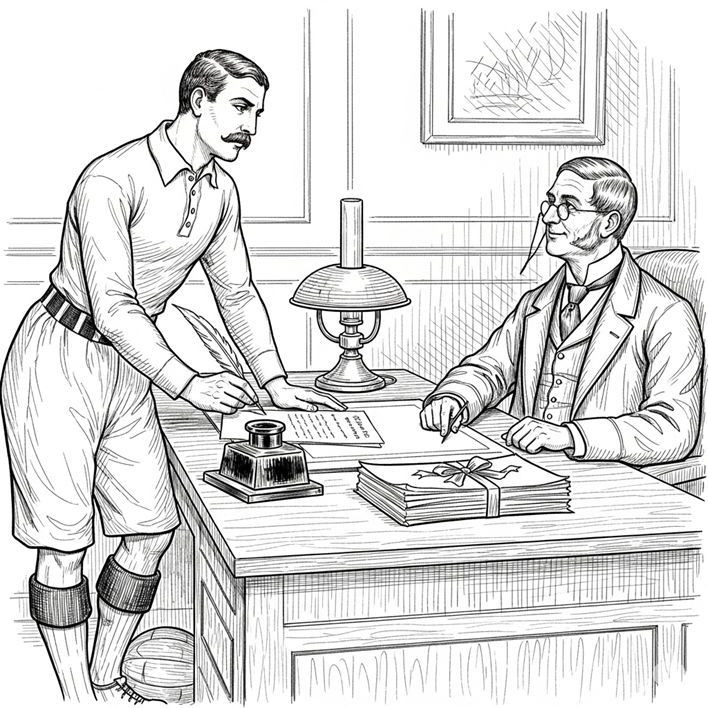

Those of my readers who expect to find “Hunting lor Men” a vivid account of an exciting cross-country run with, say, the Quom Hunt, and a kill at the finish, will be disappointed. I am no Nimrod. I have never ridden to hounds, and I can offer them no hints on how to clear a five-barred gate, and the stream instead of ignobly swimming through, in pursuit of a flying fox. My “Hunting for Men ” has been that of a football secretary.
ANXIOUS TO SECURE THE BEST KICKERS FOR HIS CLUB
And if some people think the sport inferior in interest and excitement to chasing a fox, that is because they have not gone through what I have experienced, or they would hold a very different opinion. The professional footballer is nobler quarry than Reynard— more resourceful in his efforts to throw the pursuer off the scent, more dangerous when brought to bay. I feel myself a very Othello in adventures. I may not have been called on to seek the bubble reputation at the cannon’s mouth, but
I HAVE ASSUREDLY HAD MANY HAIR-BREADH ESCAPES
by food and field, and now that my occupation is gone— l mean the dangerous part of it — l sometimes wonder how I managed to survive them all. The contrast between them and now is great indeed. Now a football secretary can sit at home at ease and negotiate peacefully for the players he wants. He has no need to cross the Border for a single player. He can get them from his own fireside.
THEN IT MEANT FORAYS INTO SCOTLAND
conducted at the risk, if not of life, at any rate of limb. The English football agent was received pretty much as an English army of invasion used to be received in the olden times, for the Scots were thoroughly roused against the poaching of their best football players by southern clubs, and they were not sparing of the horse-pond or rotten eggs when they caught the hated Sassenach poacher. As I have said, these things now belong to the past. The transfer of professional footballers from one country to another is a matter of international agreement. But, though I did not relish them at the moment, kindly time has purified the foul horse- pond and sweetened the rotten egg, and I sit down almost with a sigh to record the lost joys of those dear old, departed days. I do not envy the football secretary who has not gone through them. He has lost something in life. Fact!
Let me see — it must have been in the ‘eighties when I first became secretary to the Newcastle-on-Tyne West End Football Club. Professional football had not then attained its present enormous development in England. No doubt the game is an ancient national one, but, like other old things, it had decayed.
THE NEW LEASE OF LIFE CAME FROM SCOTLAND,
where the game had attained a perfection, even then, to which it did not attain south of the Border till long after. It is not too much to say that English football would never have become what it is but for Scottish “importations.” We are apt to forget who our mentors were now that we equal, in some cases surpass, them. And I take some credit to myself accordingly for having been among the first to introduce them to the British public.
I HAVE NO BIAS IN FAVOUR OF SCOTSMEN.
At the present time eleven out of twenty-three players for Liverpool Football Club, of which I am secretary, are English. I preferred Scotsmen because they were the best players then, and it was my good fortune to secure some of the best. For Newcastle West End I secured Ralph Aitken, of Dumbarton, a Scottish international, in 1885-6; for Newcastle East End I got J. Smith, of Kilmarnock, and J. Collins, Sheppey United. But it was in connection with the Sunderland Club that Scotsmen became most is demand, and that: my experiences in obtaining them were most exciting. Sunderland was an aspiring club, with little local football talent. It was necessary to import men of the highest class, and how the policy answered may be judged from the fact that the whole team ultimately was composed of Scotsmen, and that they thrice won the League Championship — twice in succession — thrice got into the semi-finals for the English Cup and were practically invincible on their own ground. It is questionable whether football has ever been better played than it was by the team of which I was speaking. That is not my opinion alone; it is the firm conviction of many competent judges, and footballers, not a few, look back on that as
THE GOLDEN AGE OF FOOTBALL
so to speak, which they can never hope to bring back. I dare say they idealise a good deal. Still, Sunderland’s record speaks for itself.
The getting of the men was where the trouble time in. And I do not think I should ever have succeeded to the extent I did if I had not had— first, friends in Scotland ; secondly, two staunch allies — one a wealthy gentleman who made it the passion of his life to get together the best team of footballers in the country, and did not spare himself or the money to do so; the other a clergyman of the Church of England, now holding a benefice in the North, then a curate — himself a footballer, an enthusiast in the cause, a muscular Christian, in short, of the kind that
WOULD HAVE DELIGHTED THE HEART OF CHARLES KINGLEY
Many were the jokes about the “club chaplain.” The “chaplain” was of use in more ways than one. I think the chief objections to coming to England and were urged not so much by the players themselves – their relatives were the stumbling-blocks. It is an old saying that the finest sight in the world to a Scotsman is the high road that leads to England. However, much that maybe so, and however eager the players themselves were to come, their parents would strongly object. Living all their lives in the remote parts of Scotland – or, at any rate, some of them – they were loth, naturally to part with their sons; and then there was the going to a strange country, which, to their humble pious minds, was desperately wicked, much as London is to the English bumpkin. I remember we should never be tempted one famous player’s mother to let go if the “chaplain” had not been there solemnly to promise that her son would be sent to “nae Popish conventicle with a parson in it in his shirt,” but
ALLOWED TO WORSHIP ACCORDING TO THE PRESBTERIAN FAITH,
in which had been brought up.
And, in the presence of us all, the old lady reverently knelt out the earthen floor of the humble not and earnestly petitioned the Almighty that He would be pleased to rule and direct and prosper her son. If ever a prayer was answered that was; the old lady’s son made sufficient money to retire from football eventually, and he is now a useful and well-to-do citizen of the town of his adoption. Sometimes our experiences were less edifying. The “chaplain” on one occasion
HAD NEED OF ALL HIS PRAYERS.
For his own safety. It was in Glasgow, and we three had made our headquarters at an hotel there while hunting for a celebrated player. Our presence came known to his club, and a plot was laid to entrap us. The club secretary himself called at the hotel pretending he was the player whom we wanted. He was rather shy of coming to close quarters; so we made an appointment to meet him the same night at a house in Govan-hill and settle terms. I thought it cruel hard lines that at the last moment I had a raging attack of toothache. It was a blessing in disguise. I escaped the unpleasant adventure of my two colleagues, who went without me. They were attacked in a low part of Glasgow by a mob of footballers, vowing vengeance on the “poachers”; ancient eggs flew right and left, likewise bags of yellow ochre, and more dangerous missiles still, and at last they had to take refuge in a friendly doorway and knock for admission to the house. Here they passed an anxious time until the arrival of the police, who had been drawn to the spot by the row; half a sovereign rewarded their kindly host, and then, escorted by a large body of Glasgow police, they arrived back at the hotel, not without a parting salute of eggs and ochre from the disappointed mob. The “chaplain,” I must say
BORE A VERY UNCLERICAL APPEARANCE
It was rumoured afterwards, at home, that I was the “chaplain,” having disguised myself with his clothes; but, as I have said, I was saved by the toothache, probably the only instance on record in which the toothache ever did anybody any good. I would go through it again under the same circumstances.
After that, when in Glasgow, we adopted different tactics. Each of us stayed at a different hotel. The trick was simple enough, but it never failed to work at night. I would then call, in a cab, on my colleagues, pretend to take each of them up in turn, and drive off, followed by a crowd of angry Scots vowing vengeance on the English thieves who were stealing all their best players. When the enemy were out of sight the other two gentlemen set about business unmolested. I engaged the attention of the crowd till it was time to return, and
“CAPITAL BAGS, OLD MAN,”
was the news that saluted me when I went to inquire next morning how the ruse had worked.
Of course, we were not uniformly successful. We bad to put up with many disappointments, and perhaps the keenest of these to me at the time was in the case of a well-known Scotch international on whom I had set my heart. He had as many minds as a chameleon has hues, and he changed them as often. He accepted £20 from me to come at last, and I thought I had him safe. It was only to cry off again, and we had considerable difficulty in getting back the £20. We did in the end— without the player. I believe that afterwards he really did come to England. He was a great failure, and went “home ” again, so that here once more Fortune was my friend, though his appearance was as forbidding as that little attack of the toothache. One never knows his luck. I don’t think I have said anything yet about
MY QUEST AFTER A FOOTBALLER AT SOME DYNAMITE WORKS,
near Saltcoats in Ayrshire. It was not a job that I relished. There had been an explosion just before at some dynamite works, and half-a-dozen men were blown into the air, and came down, in little bits, about a fortnight later. They may not have been the same dynamite works, but I did not stop to distinguish; I hated them all alike, and if I could have put the job on to anybody else’s shoulders I would have cheerfully resigned the task. The lot fell on me, though, and go I had to. The result was not an explosion, or rather not one of the deadly kind. An explosion there was, a wrathful shout when the fellow workers of the player saw what I was about. I did not see him, and did not wait to, with a howling mob at my heels.
THEY RAN AND I RAN
It was a mile to the railway station, and I can fairly say I came nearer to breaking the record on that occasion than I shall ever do again. While still retaining a pretty good opinion of myself, I must candidly say that I could not do the performance again. I was younger and slimmer then than I shall ever be in the future, and I reached the City of Refuge first— the railway station, I mean caught a waiting train— the only friendly thing at hand— and had soon placed a safe distance between myself and Saltcoats. Dynamite works or no dynamite works, I would not have gone back while that crowd was about.
I was not the only football secretary hunting for players in Scotland, as you may imagine. There were others, or rather I am thinking of one who was a rival for the hand, perhaps I ought to say foot, of a well-known player. The mistake he made was in
TRUSTING TO A TELEGRAM TO SETTLE THE BUSINESS.
The telegram came to the player’s house while I was out with him. It urged “Jim ” to sign only for that club. But “Jim” during the walk had promised to sign for no other club than Sunderland, and he kept his word. A man on the spot is worth any number of telegrams. And so I could go on telling of other escapades— of drives down lonely lanes at dead of night, as the safest way of getting at a player whose house was watched; of awkward spills in the roadway, though breaking no bones; of arriving on the scene at the wrong moment, say just when a team had won a match and the player I particularly wanted had done most to win it. That unhappy conjunction of circumstances — no fault of mine, I need hardly say— appeared to drive every body to a singularly emphatic outburst of frenzy. I suppose I must have looked to them like the butcher who has come to take away the pride of the flock. And I had to flee, or, rather, the horse had. How often have I regretted at such crises in my existence that I am not a cyclist. All things considered, I have been exceptionally successful in “Hunting for Men.” Some of the players signed on by have been already named. Others secured tor Sunderland were J. E. Doig, T. Porteous, Donald Gow, J. Stevenson, J. R. Auld, W. Gibson, J. Harvey, J. Campbell, H. Wilson, J. Gillespie, D. Hannah, J. Hannah, J. Scott, J. Murray, J, Miller, and McCreadie. These names used to be as familiar household words in all footballers’ mouths; many of them are still—names of
MEN WHO HAVE CAPTAINED THEIR COUNTRY AGAINST ENGLAND
like Donald Gow, at the age of nineteen, the youngest captain ever known; like Doig and Wilson, who have gained almost every honour be gained in football; and like Miller, still a prominent player for the Glasgow Rangers. Since becoming secretary of the Liverpool Football Club I have signed many more. But these had been secured by the transfer system. And here my theme must end. “Hunting for Men ?” There is no necessity for it now. A Secretary’s Experiences ? ” I have told you mine—at any rate, the more exciting of them. I have only to add that, in spite of them, I have many friends in Scotland, and none more friendly than some of those with whom I used come conflict in the old days. We learnt to respect each other rivals, and are all the better cronies, I think, for the mutual appreciation bora of the strife in “Hunting for Men.”