
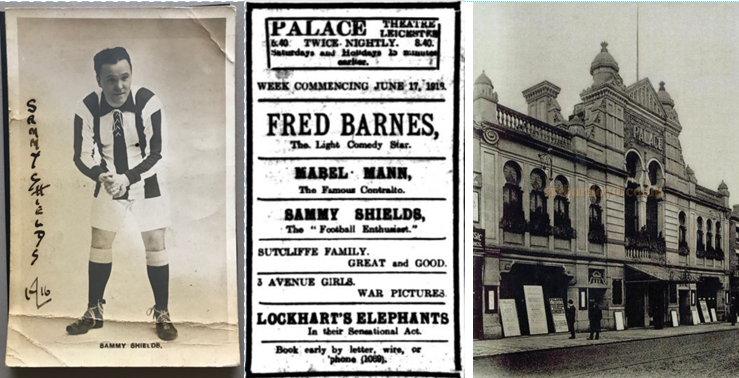
The Palace Theatre of Varieties, a grand and bustling hub of entertainment that once graced Belgrave Gate in Leicester, may be long gone, but its history lives on through the stories of the performers who graced its stage. Among the many variety acts that entertained audiences in the first half of the 20th century was Sammy Shields, a well-known “Scotch comedian” whose unique blend of humour and poignant storytelling connected him to the very real struggles of World War I.
Constructed in 1876 as the Floral Hall, and was intended to be a massive skating rink, the building was later transformed by renowned architect Frank Matcham into the magnificent Palace Theatre in 1901. With a seating capacity of 3,500, it was an entertainment colossus, the largest of its kind outside London. Throughout its golden years, the theatre hosted a galaxy of stars, including Peter Sellers, Benny Hill, and Shirley Bassey. Yet, in the midst of this star-studded history, the story of Sammy Shields offers a fascinating glimpse into the life of a working performer during a time of global conflict.
Born Alexander Young in Glasgow in 1872, Shields began his career as a stockbroker’s clerk before the lure of the stage proved too strong. He honed his craft as an amateur performer and by 1905, he had fully committed to a career in music hall. His rise was steady, and by 1913, he was a notable figure, even participating in a charity football match at Stamford Bridge alongside other music hall artistes.
When the Great War began, Shields, being in his 40s, was over the age for military service. This allowed him to continue his career, touring Britain and bringing a much-needed sense of levity to a nation at war. However, his performances were not entirely detached from the conflict. In June 1918, when he took to the stage at the Palace Theatre in Leicester, his act was said to include a deeply moving piece of history.
As reported by the Western Morning News in 1916, Shields’s act featured a football—a simple prop that held an extraordinary story. He would recount how the ball had been given to him by Major Buckley of Bradford City, and how it had been used in a football match on the front lines in Flanders between the “Footballers’ Battalion” (17th Middlesex) and the Royal Field Artillery. Most remarkably, the ball bore the signatures of 43 famous footballers serving on the Western Front. It was a tangible link to the sacrifices being made, blending humour with a touching moment of pathos that resonated deeply with audiences.
Throughout the war and beyond, Shields’s act evolved. He often endeared himself to local crowds by wearing a football shirt in the colours of the town’s club. His songs, too, were popular, with his 1923 tune “A.B.C. of Football” even being released as a record. Shields continued to tour extensively, even embarking on extended trips to Australia and South Africa in the late 1920s.
Shields’s life, a testament to the enduring spirit of music hall, came to an end in 1933. He died in a nursing home in Brixton, not far from the home he had kept for over a decade. He is buried in West Norwood Cemetery, leaving behind a legacy as a performer who not only entertained but also served as a unique chronicler of his time, connecting the world of music hall to the harsh realities of the battlefield.
The Palace Theatre, which served as a stage for his artistry, faced a similar fate of decline. By the late 1950s, the rise of television led to its demise, and it closed its doors for the final time in February 1959 before being demolished. Today, the site where this great theatre once stood is a stark reminder of Leicester’s ever-changing landscape. Yet, through stories like that of Sammy Shields, we can still catch a glimpse of the vibrant world of entertainment that once thrived there, a world where comedy and courage shared the stage.