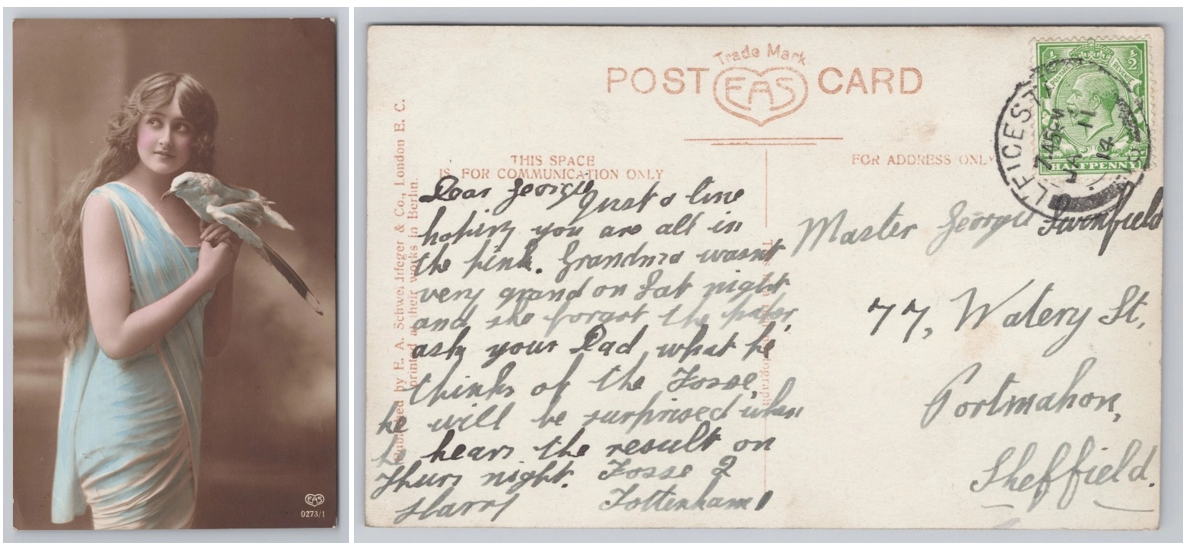
History is often found in the margins, and a postcard currently on eBay offers a fascinating, personal glimpse into a week that shook the foundations of Leicester Fosse. Dated January 11, 1914, the message from “Harry” to “George” isn’t just a piece of family correspondence; it’s a time capsule of a fan’s unbridled optimism on the eve of one of the most famous matches in the club’s history.
The postcard’s most striking line is a piece of sporting prophecy: “He will be surprised when he hears the result on Thurs night. Fosse 2 Tottenham 1.” To understand the weight of this, we have to look at the calendar. Harry wrote this on a Sunday. Just the day before, on Saturday, January 10, Leicester Fosse had played out an extraordinary 5-5 draw with Tottenham Hotspur in the first round of the FA Cup at Filbert Street. It remains one of the highest-scoring draws in the history of the competition and a game that left the 22,000 fans in attendance breathless.
That Saturday match was a true “muck-and-nettles” classic. Fosse, the Second Division underdogs, refused to be intimidated by their top-flight opponents. The lead changed hands with dizzying frequency as the Fosse staged an incredible comeback. The goals that day were a team effort: Sam Currie and Fred Mortimer each found the net, but the undisputed hero was Claude Stoodley, who hammered home a magnificent hat-trick. Every time Spurs thought they had killed the game off—led by a hat-trick of their own from star forward Bert Bliss—the Fosse roared back. The roar of the Filbert Street crowd was said to be heard across the city as the local boys fought back to earn a replay.
Because the game ended in that staggering stalemate, a replay was scheduled for the following Thursday night, January 15, at White Hart Lane. Harry wasn’t just guessing; he was placing a confident “bet” via postcard that the momentum from Stoodley’s hat-trick would carry the Fosse to a 2-1 upset in London. Unfortunately for Harry, the magic of the first game couldn’t be replicated; Spurs tightened their defence and won the replay 2-0.
Beyond the football, this postcard serves as a reminder of the staggering efficiency of the 1914 postal service. In an era long before WhatsApp or social media, the postcard was the primary tool for “instant messaging.” In 1914, urban areas often enjoyed up to six to ten deliveries a day. Harry could post a card in the morning, and George would likely have it by the afternoon. This level of speed allowed people to coordinate their social lives in real-time, arranging a night out or a trip to a match with just a few hours’ notice.
The postcard was the social media of the working class—cheap, fast, and accessible. A simple “line” was enough to check if everyone was “in the pink” or to let a father know about a midweek football fixture. At just a halfpenny for postage, it was the most efficient way to stay connected, which explains why millions were sent and collected in elaborate albums during this golden age of the postal system.
There is a poignant undertone to Harry’s mundane updates about “Grandma” and her “forgotten xxxx.” This card was sent in the final months of the Edwardian era’s long summer. Just seven months later, in August 1914, Great Britain would be at war, and the carefree world of football and halfpenny postcards would be irrevocably changed. Many of the men who stood in the crowds for that 5-5 thriller, and the players on the pitch themselves, would soon be in the trenches of the Western Front.
Leicester Fosse itself would struggle to survive the war years, losing several players to the conflict—including goalscorer Fred Mortimer, who tragically died in service—and eventually reforming as Leicester City in 1919. This postcard remains a ghost of a simpler time: a Sunday morning in January where the biggest concern was a grandmother’s health and the hope that, come Thursday night, the Fosse would finally get one over on the Spurs.