
Long before the days of high-tech hydration salts and personalized nutrition plans, the titans of the English pitch were fuelled by something much meatier. The brand we know today actually began in the mid-1800s as a scientific breakthrough by German chemist Justus von Liebig. His “Liebig’s Extract of Meat” was designed to provide affordable nutrition to the masses, eventually rebranding as the catchy “Oxo” in 1899 to become a household name.
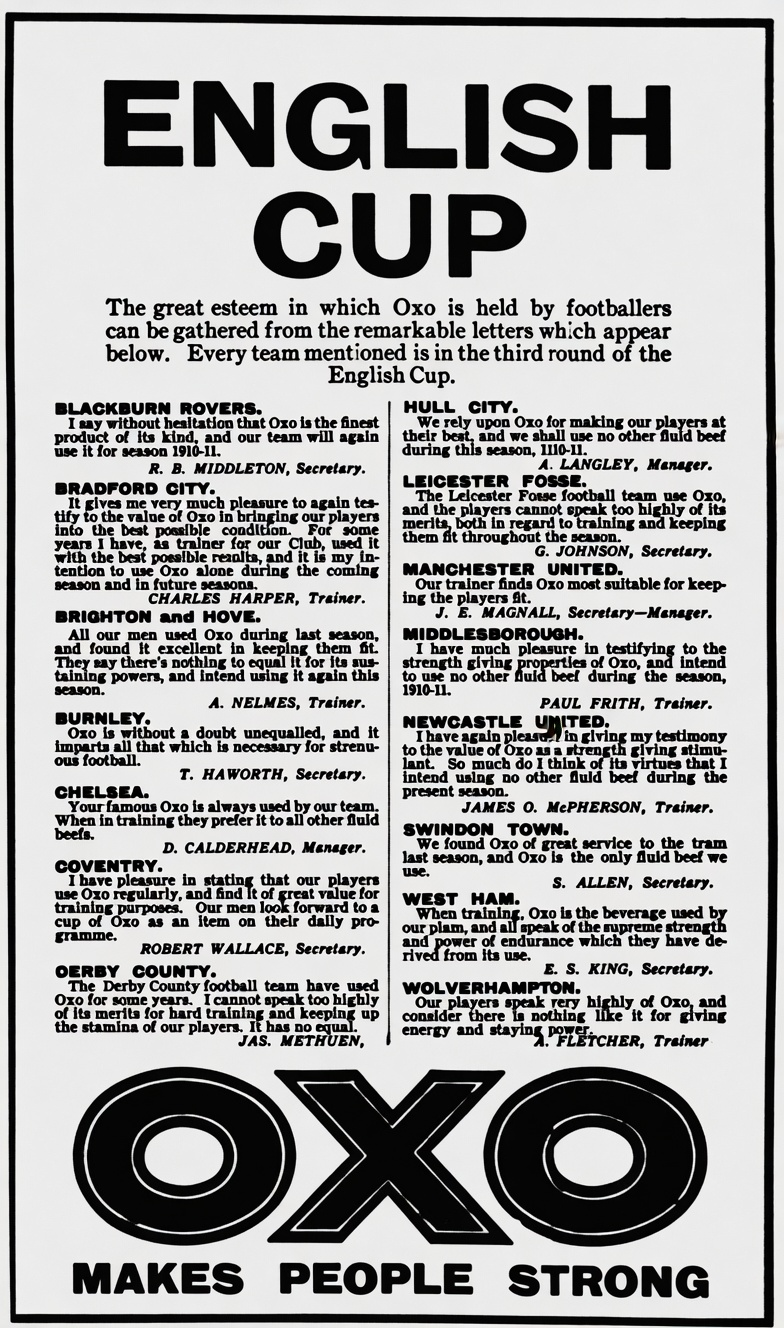
By the early 1900s, specifically during the hard-fought 1910-11 English Cup campaign, Oxo wasn’t just a kitchen staple; it was the secret weapon of the footballing elite. From the training grounds of Blackburn Rovers to the locker rooms of Manchester United, trainers and managers swore by this fluid beef as the ultimate stimulant for their squads. Even the team at Leicester Fosse was famously vocal about their loyalty to the brand, with club officials noting that their players used Oxo to maintain fitness throughout the gruelling season.
The endorsements from this era read like a roll call of legends. The giants of Chelsea and Newcastle United relied on its strength-giving properties to survive the most strenuous matches, while West Ham’s officials credited it with providing a supreme level of endurance. Whether it was Hull City looking for a way to keep their players at their absolute best or Swindon Town refusing to use any other brand, the message across the league was clear: stamina came in a cup.
This relationship deepened when the iconic Oxo cube was launched in 1910, the same year it was being touted by top-tier football clubs. It transformed from an athlete’s “fluid beef” into a wartime essential for troops in the trenches and, eventually, the cornerstone of the British home-cooked meal. It was a golden age of sports marketing where the beautiful game and a hot mug of beef extract walked hand-in-hand toward glory, all built on the simple, bold promise that Oxo makes people strong.