
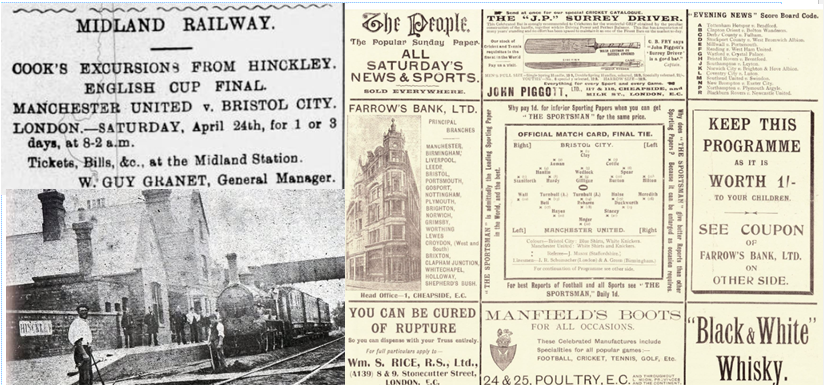
Long before motor coaches, dual carriageways or supporters’ buses, football in England grew on the rails. In the decades leading up to the First World War, the railway network became the engine that powered the sport’s expansion, carrying players, officials and — most importantly — supporters across the country. What had once been a patchwork of local fixtures quickly evolved into a national calendar because rail travel made distance manageable. Clubs could arrange matches far beyond their immediate district, strengthening competition and encouraging tactical and organisational development. The FA Cup, in particular, blossomed into a truly national tournament thanks to the ability of teams and fans to travel cheaply and reliably.
For working people, railways opened the door to football as an experience rather than simply a result read in Monday’s newspaper. Excursion trains became a cultural phenomenon. No company embraced this new sporting enthusiasm more effectively than Thomas Cook, founded in Leicester in 1841. Originally organising temperance excursions, Cook quickly recognised the potential of rail travel for leisure and mass events. By the late Victorian era, the firm was arranging thousands of excursions each year — seaside trips, industrial outings, and increasingly, football specials. Cook’s Leicester headquarters became a hub for supporters seeking affordable, organised travel to major matches.
The 1909 FA Cup Final is a perfect example of this partnership between railways and football. Thomas Cook advertised a Midland Railway excursion from Hinckley, offering local fans the chance to travel to London for the biggest match of the season. For a modest fare, supporters could board a dedicated train, enjoy the final at the Crystal Palace, and return home the same evening. It was football tourism in its earliest form: structured, democratic, and rooted in the excitement of rail travel.
That final — Manchester United vs Bristol City — drew a crowd of 71,401, a huge attendance for the era. United won 1–0, Sandy Turnbull scoring the decisive goal. Many of those spectators arrived on organised excursions just like the one from Hinckley, demonstrating how railways enabled football to become a truly national event.