
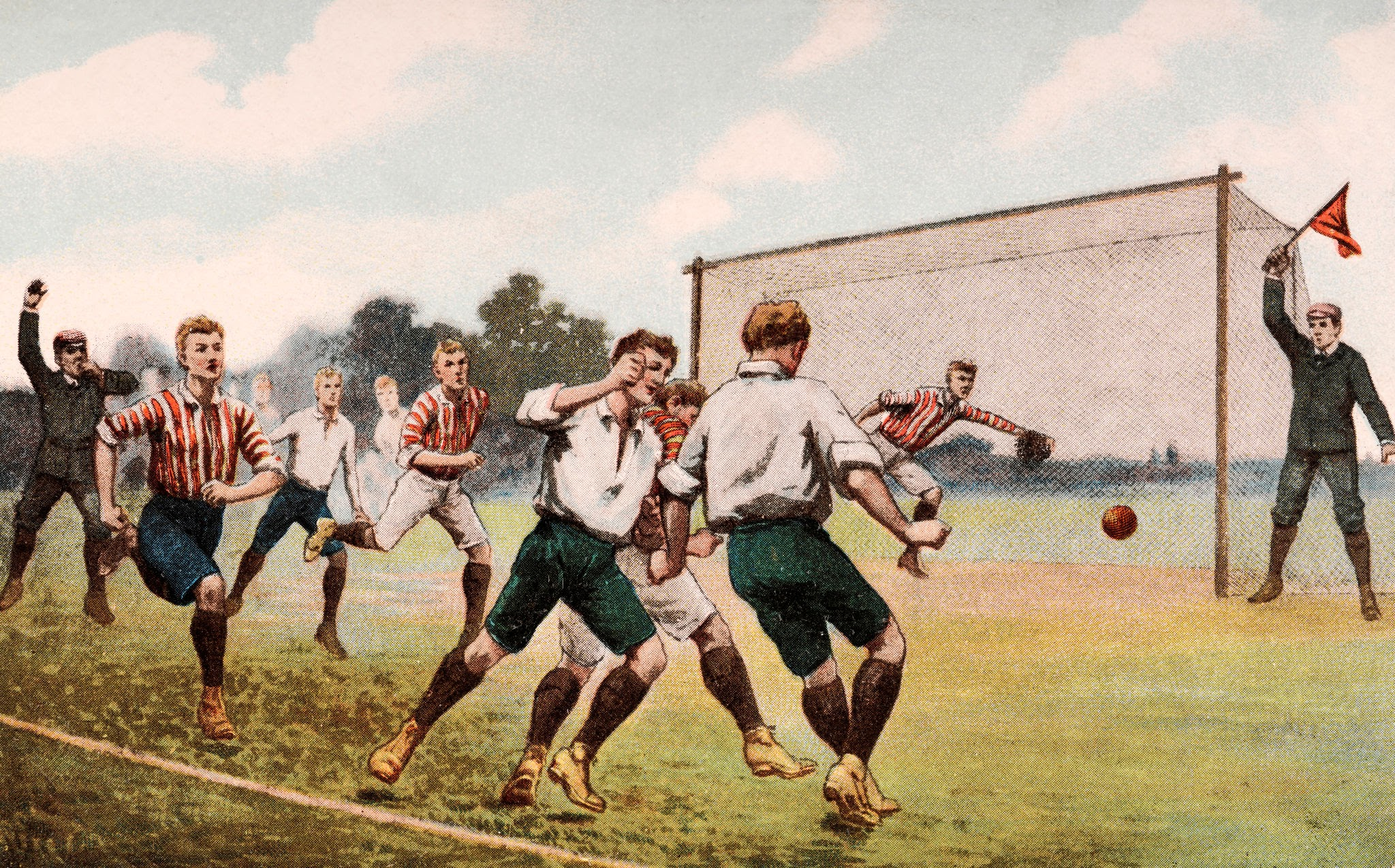
Modern football fans often lament the soft tackles, strict refereeing, and constant whistle-blowing of today’s sport. Yet the historical record of 19th-century association football reveals a game fought at the perilous edge of survival. In the late nineteenth century dozens of young men paid the ultimate price for playing the game they loved. Played on frozen mud, littered with debris, and governed by officials without the power or medical knowledge to stop play, Victorian football was as dangerous as it was popular.
The Fatal Leicestershire Incurables
The physical toll of this era reached into every corner of Britain, including Leicestershire. In September 1889, Thomas Spittle, playing for the village side Packington against Small Heath reserves, collided with an opponent while competing for a 50/50 ball. Although there were no external signs of injury, Spittle was struck with continuous vomiting. He was rushed to the hospital and passed away two days later from severe internal trauma.
An even more surreal tragedy struck Leicestershire’s sporting scene in May 1896, involving 25-year-old Scottish international James Logan. Logan, who had famously scored a hat-trick in the 1894 FA Cup Final, was playing for Loughborough in a match where torrential rain soaked the players to the skin. Loughborough had no dry secondary kit for their team, forcing Logan to travel home and subsequently play his next match in the exact same cold, wet, unwashed uniform. He contracted acute pneumonia on the pitch and died shortly after, buried in an unmarked pauper’s grave in Loughborough.
Bizarre Fatalities and Pitch Hazards
The accounts preserved from this period illustrate just how precarious match conditions were, both on and off the turf:
- Fatalities Beyond the Pitch: In 1877, George Beamont of Owlerton jumped onto a stone wall alongside Dark Lane to retrieve an out-of-bounds ball. The masonry gave way, sending him plunging 60 feet into a quarry below.
- Tetanus on the Turf: Pitches were often unkept public grounds. In 1892, St Mirren’s 21-year-old star James Dunlop fell onto a jagged piece of glass embedded in the pitch. He contracted tetanus and died ten days later.
- The Deathbed Confession: In 1886, Alfred Turner of Farnworth Standard suffered fatal internal injuries charging an opponent. On his deathbed, Turner called for witnesses to record an official legal statement exonerating his opponent of all blame, ensuring the man would not face criminal charges.
- The Mid-Game Collapse: In 1879, Reading captain Harry Rogers stopped mid-match feeling “bilious.” While someone ran to fetch him a glass of brandy, Rogers intercepted a pass, cheered his goalkeeper for a save, lay down on the penalty spot, convulsed, and died of an epileptic fit.
Spectator Danger and Mismanaged Traumas
A lack of medical understanding often turned minor injuries fatal. A simple thigh bruise killed Charles Bache in 1885 when it turned septic, leading to acute blood poisoning. Similarly, James Harkins died months after a knee-to-thigh blow developed into a deep, incurable internal abscess. In other cases, medical care was deliberately withheld because crowds assumed players were faking; Dalmuir Thistle’s Thomas Anderson was left in agony for hours after being kneed in the abdomen because spectators believed he was exaggerating his pain.
The danger even followed players off the pitch. In 1897, Workington’s John Fisher helped his team win the Cumberland Senior Cup. As the trophy was being presented, angry rival supporters began pelting the winners with rocks. A stone struck 19-year-old Fisher in the temple, causing brain injuries that killed him eight months later.
The Evolution of the Rulebook: How Bloodshed Empowered the Referee
Throughout the 1870s, severe internal injuries were routinely dismissed as “accidental outcomes of fair charging.” It took a tragic trail of organ ruptures, septic injuries, and pitchside deaths to transform refereeing from a passive hobby into an authoritative system of player protection.
- 1881–1889 (Targeting Foul Play): Following growing public outrage over brutal tackles, the Football Association updated Rule 13 in 1881 to allow referees to expel a player from the pitch without waiting for an appeal from team captains. By 1889, the FA explicitly criminalized “tripping, kicking, or jumping at an opponent,” instructing referees to judge the danger of a challenge rather than simply whether a player touched the ball.
- 1891 (The Penalty Kick & Central Authority): Prior to 1891, defenders routinely used dangerous, high-impact tackles near the goal line because the maximum penalty was merely an indirect free kick. The invention of the penalty kick created an immediate tactical deterrent. Simultaneously, referees were moved off the sidelines and directly onto the pitch with full authority over play.
- 1893–1898 (Medical Stoppages & Pitch Inspections): In 1893, the FA codified that referees MUST halt play immediately for severe injuries, dismantling the culture of forcing injured players to carry on. By 1898, officials were required to conduct pre-match pitch inspections to clear hazardous debris like glass or metal nails, while inspecting players’ boots to ensure sharp metal studs were barred.
The Modern Legacy
The modern referee’s arsenal—from yellow and red cards to VAR reviews for serious foul play—is the direct descendant of these early safety reforms. The forgotten pioneers of Victorian football never knew multi-million-pound contracts or modern pitchside medical teams, but every safety protocol, pitch inspection, and protective rule in today’s game stands as a quiet monument to their sacrifice.