
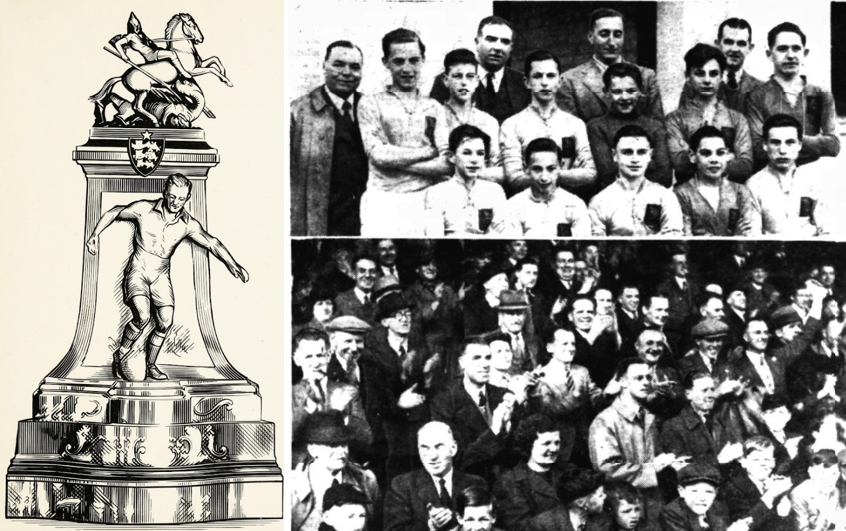
Eighty years ago, as the nation emerged from the shadow of World War II, a group of twelve schoolboys achieved something that forever etched their names into the sporting folklore of Leicestershire. In the spring of 1946, the Leicester Schools’ Football Association (LSFA) captured the coveted English Schools’ Shield for the first time in its history—a triumph of skill, determination, and unyielding team spirit. The English schoolboys’ trophy won by Leicester boys in 1946—this 100 guineas trophy which replaced the historic shield—was presented to the schoolboys’ association by Mr. S. F. Gill, a member of the schools’ council for 25 years.
A 53-Year Quest for Glory
Founded in 1893, the LSFA had waited 53 long years to bring the premier prize in schoolboy football home to Leicester. The 1945–46 campaign was a grueling test of resilience, requiring the team to travel away from home for five of their nine tournament matches.
Yet, from their opening fixture, Leicester Boys proved to be an unstoppable force, racking up 51 goals while conceding just six:
- Away: v. North Leicestershire — Won 16–0
- Home: v. Peterborough — Won 5–0
- Home: v. Luton — Won 13–0
- Away: v. Halesowen — Won 3–2
- Away: v. Swansea — Drew 1–1
- Home: v. Swansea — Won 2–0
- Away: v. West Ham — Won 4–2
- Home: v. Stockton — Won 4–1
- Away: v. Stockton — Won 3–0
A Record-Breaking Day at Filbert Street
The pinnacle of the campaign came on May 11, 1946, when Leicester met Stockton Boys in the first leg of the final at Filbert Street. The city was gripped by football fever. An official attendance of 32,904 packed into the ground, generating gate receipts of £2,808—a national record for the English Schools’ Football Association at the time. Thousands more turned up, eager to catch a glimpse of the young stars who had captivated the community.
The Famous Twelve

Remarkably, over the course of the entire grueling tournament, only 12 players were called upon to wear the city shirt. Their names belong to local footballing royalty:
Heathcote, Torr, Hincks, Barnett, Lancaster, Hallam (Captain), Harrison, Baxter, Slynn, Tipton, Pollard, and Tibbles.
Behind their on-pitch brilliance was a dedicated network of schoolmaster officials whose voluntary work laid the groundwork for success.
Visionaries Behind the Scenes
For Mr. A. C. Robinson, the triumph was the culmination of a quarter-century of devotion. Having served as Secretary to the LSFA for 25 years, “A.C.” saw his boys reach the pinnacle of schoolboy football on the eve of his final season in office. His brilliant organization and vision placed Leicester at the absolute forefront of school soccer associations nationally.
The victory was equally personal for Mr. C. Page, a founder member of the LSFA, who had championed local schoolboy talent for decades.
The achievement was celebrated in a special souvenir edition of the Leicester Evening Mail, earning tributes nationwide. Crucially, the success was also built on a strong partnership with Leicester City Football Club, who consistently opened Filbert Street to the schoolboys, providing pitch facilities, office setup, and groundskeeping support. Following the cup run, LCFC formulated a official development scheme to nurture these young talents as they transitioned into the adult game.
A Lasting Legacy
Eight decades on, the 1946 victory stands as more than just a list of scores. It sparked a wave of local pride, awakened civic leaders (“the City Fathers”) to the urgent need for more public playing fields in industrial Leicester, and inspired generations of young footballers to come.
As we look back 80 years later, the lesson of 1946 remains as clear as ever: that football, when organized by men of vision and played with true team spirit, brings immense lustre to a city and builds character that lasts a lifetime.