
The story of Symington’s F.C. offers a brilliant window into the golden age of British industrial works football. It was an era when factories provided the heartbeat for both local economies and community sports, turning everyday tradesmen and factory workers into regional footballing heroes.
The Late-Victorian Genesis & The Friendly Era (1880s–1890s)
While many historical accounts pinpoint the club’s peak eras to the mid-20th century, the competitive spirit of the “Corsetmakers” actually stretches deep into the Victorian era. Symington’s F.C. was originally formed in the early 1890s, having grown out of informal workplace games played since the late 1880s. During this era, R. & W. H. Symington & Co. had become one of the first highly mechanised corset factories in the world by introducing mass-production sewing lines to Market Harborough. As the male workforce grew alongside the massive female labor force, the factory men organized a team. Rather than playing in structured league systems—which were still in their infancy outside of the professional game—the club spent the vast majority of the late nineteenth century playing high-profile friendlies, challenge matches, and local charity exhibition games. These early decades of unaligned friendly fixtures allowed the team to sharpen its teeth against established civic teams, building a formidable local reputation long before they officially entered league football.

The Factory Roots and Club Identity
The club was born directly out of R. & W. H. Symington & Co. Ltd in Market Harborough, Leicestershire. Famous for creating the iconic “Liberty Bodice,” the factory was the area’s dominant employer. Following a trend of progressive corporate welfare and industrial paternalism—spearheaded significantly in the 1890s and 1900s by Miss Perry Gold Symington (the factory’s influential ‘lady supervisor’)—the company invested heavily in its workers. They opened a dedicated employee welfare club room in 1901 and eventually established a massive, unified company sports ground in 1919.
The football team proudly wore amber and black kit colours (often in vertical stripes or amber shirts with black trim), reflecting a corporate identity that visually set them apart from traditional civic clubs. They were known affectionately to local supporters simply as “Symingtons” or “The Corsetmakers.”
The Home Ground: Symington’s Recreation Ground

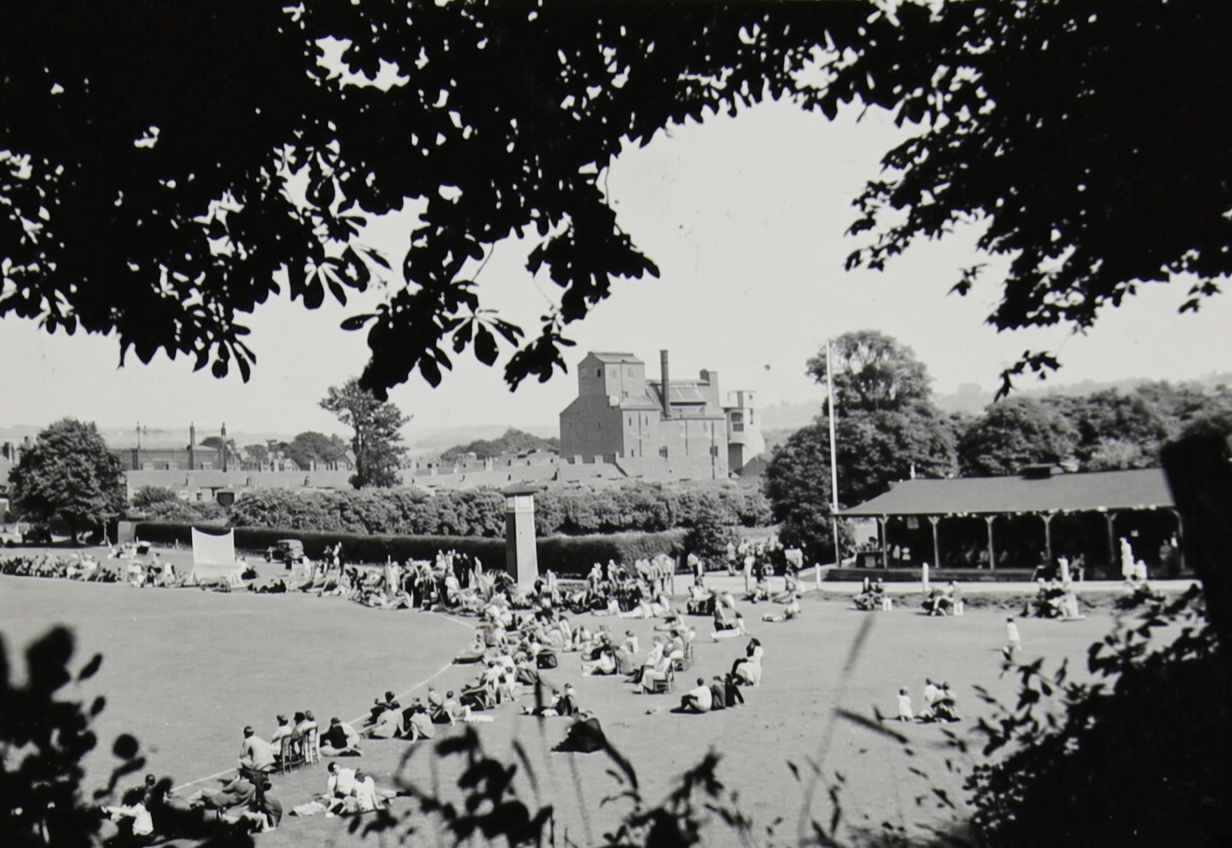
The team played their home matches at the company’s private sports field on St. Mary’s Road, Market Harborough. Known historically as the Symington’s Sports Ground (and today operating as Symington’s Recreation Ground), it was a highly regarded facility in regional amateur football, featuring a meticulously manicured pitch, perimeter banking for spectators, and on-site changing pavilions.
The ground frequently hosted prestigious local cup finals and grand factory celebrations—such as the massive 1956 factory centenary which saw grand marquees, motorcycle stunt riders, and floodlit spectacles on the playing fields. Decades after the factory’s senior team dissolved, the ground remained an incubator for local youth sports; the modern-day Harborough Town F.C. originally played at Symington’s before moving to Northampton Road in the 1990s.

Rise and Regional Dominance
Following their long nineteenth-century apprenticeship in friendly football, Symington’s F.C. established themselves as a regional powerhouse by systematically conquering different tiers of the regional football pyramid:
The Early District Era (1914–1931): Transitioning fully into competitive league structures, the club dominated the localized Market Harborough & District League, winning the 1914/15 title before World War I intervened. They returned to lift the title again in 1930/31, while their highly competitive Reserves squad scooped up the 1926/27 championship.
The Amateur Alliance Powerhouse (1933–1947): Seeking a higher level of play, they migrated into the highly competitive Kettering Amateur League (East Midlands Football Alliance). Across the late 1930s and 1940s, Symington’s was the team to beat, capturing the League Championship in 1934/35 and again in 1946/47, alongside a prestigious Leicestershire County Junior Cup South title.
The United Counties League Peak (1947–1955): In 1947, the club took a massive step up by joining the semi-professional United Counties League (UCL). This era tested the factory’s depth, culminating in the early 1950s when the first team secured consecutive top-tier finishes (5th in 1952/53), while the Reserves clinched the UCL Division Two Championship in 1951/52.
Complete Honours List
First Team
East Midlands Football Alliance (Kettering Amateur League): Champions: 1934-35, 1946-47; Runners-Up: 1933-34, 1937-38
East Midlands Football Alliance (Division One): Champions: 1965-66
Kettering & District Combination: Runners-Up: 1925-26
Market Harborough & District Football League: Champions: 1914-15, 1930-31; Runners-Up: 1929-30
Leicestershire County Junior Cup South: Winners: 1925-26; Runners-Up: 1937-38
Reserves Team
United Counties League (Division Two): Champions: 1951-52
East Midlands Football Alliance: Champions: 1947-48
Market Harborough & District Football League: Champions: 1926-27
Notable Matches & Historic Campaigns
Several specific campaigns and fixtures define the folklore and competitive grit of the Corset makers:
The Golden Double Campaign (1925-26)
This stands out as one of the most action-packed seasons in the club’s early league history. Symington’s fought an exhausting two-front war in local cup and league play. The defining match of their season was the Leicestershire County Junior Cup South Final, where they clinched a hard-fought victory to bring county-level silverware back to Market Harborough. The momentum almost carried them to a historic double, but they narrowly missed out on the league title, finishing as runners-up in the Kettering Combination.
The Post-WWII Title Decider (1946-47)
When competitive football fully returned after World War II, the factory team assembled one of its most dominant squads. Playing in the East Midlands Football Alliance, they treated the local spectators to high-scoring, aggressive attacking football. The definitive match of the season was a late-season title decider that secured them the 1946/47 Championship, cementing their status as the premier post-war amateur team in the region and directly prompting their ambitious jump to senior football.
The Reserves Rule the UCL (1951-52)
In the 1951/52 season, Symington’s historical spotlight actually fell on the Reserves. While the first team was holding its own against tough senior clubs, the Reserves went on a spectacular tear through the UCL Division Two. Facing off against the reserve sides of major regional teams, they clinched the Division Two Championship in clinical fashion. It remains a legendary testament to the club’s incredible depth, proving that the factory’s second-string side was capable of outplaying top-tier local talent.
The End of a Senior Era (1954-55)
The club’s final home match in the United Counties League in 1954 marked the sunset of high-level factory football. For over half a century, Market Harborough residents had walked down to the St. Mary’s Road ground to watch top-tier regional football. Following their exit in 1954 (and a brief stint in the Birmingham District League), senior UCL football completely vanished from the town for 56 years, until the modern-day Harborough Town F.C. finally earned promotion back to the league tier in August 2010.
Sunset of the Corset makers
By the mid-1950s, the club had reached its competitive zenith. However, maintaining a multi-team senior football club grew increasingly difficult as industrial operations and workplace recreational cultures began to shift across postwar Britain.
The team stepped back into local amateur leagues, enjoying one final grand hurrah by winning the Kettering Amateur League Division One title in 1965/66. The football club faded out of competitive existence around 1970, mirroring the eventual decline of the textile industry itself. The grand Church Gate factory finally closed its doors in 1990 and was later beautifully repurposed as the Harborough Museum and local council offices, while the St. Mary’s Road sports ground remains a protected, vibrant green space for public football to this day.