
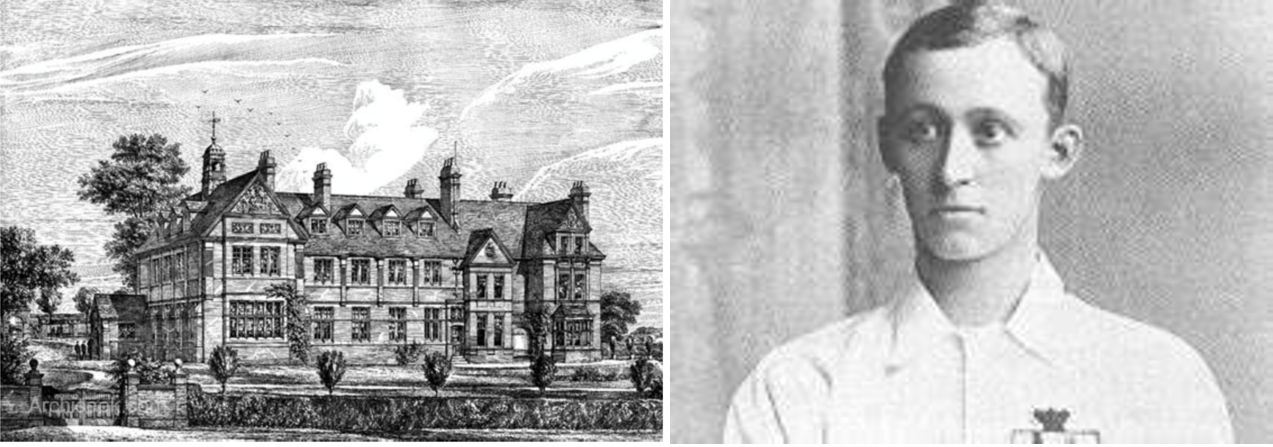
Local football folklore is stitched through with David-versus-Goliath tales — upsets forged in mud, wind, and sheer grit — but few carry the resonance, or the sheer audacity, of the afternoon that unfolded on the cricket field at Market Harborough on 22 October 1892. For years, Wellingborough Grammar School had stood unchallenged as the powerhouse of regional football: tactically polished, athletically elite, and utterly unbeatable by their neighbours. Harborough, by contrast, had never once beaten them. That windy Saturday, however, history was rewritten in a “brilliant victory” that would be recounted in pubs, club meetings, and family homes across the town for decades to come.
What lifted this win far above ordinary local triumph was the name on the opposition team sheet: Arthur George Henfrey. Not merely a good player, but a genuine English international — one of the most celebrated amateur sportsmen of his age — turning out for his old school in a match that would pit local pride against national renown.
The Match: Written in Wind and Determination
Contemporary reports paint a vivid picture of Victorian football at its most robust and compelling, played before “a goodly number of spectators” who had gathered in eager anticipation. Wellingborough Grammar School (pictured above) arrived with a powerful eleven, built on a reputation for stylish, progressive play, and featuring Henfrey — an international star — at its heart. Harborough, the “red and whites”, stood firm, but knew they faced their sternest test.
The home captain won the toss and chose to play with the wind at his back, a decisive call on a day when the gale blew straight down the length of the field. The opening exchanges were even, end-to-end and keenly contested, but it was Harborough who soon seized the initiative. The School’s forwards showed neat, clever passing, yet the home defence was never caught “napping”: Shannon and Grimsley stood resolute, repelling every advance to turn play back towards the Wellingborough goal.
Wave after wave of Harborough pressure followed, and at last Stokes — ever alert to his chance — struck with one of his trademark shots to claim the opening goal, met with loud and genuine applause. McDermott soon doubled the lead with a fine, neat finish, and before half-time Grimsley added a third, leaving Harborough in command at the interval:
Harborough 3 – 0 Wellingborough Grammar School
The second half brought a sterner test. Now Harborough faced the wind, and Wellingborough — with Henfrey to the fore — launched a sustained siege. The international forward showed exactly why he was held in such high regard: quick, skilful, and constantly probing, he came close on multiple occasions. Yet he found his match in Grimsley, who watched him with “a cute eye”, anticipating every move and blocking every final effort.
For twenty minutes the home goal held firm. Then, from a corner, Carter headed through his own net to give Wellingborough a foothold, and as the game drew to a close Fishwich scored again to cut the gap to a single goal. Excitement surged; the crowd grew tense. But Harborough’s defence would not yield. The whistle blew, and the score stood:
Harborough 3 – 2 Wellingborough Grammar School
Harborough Team: Goal: Price; Backs: Shannon and Carter; Half-backs: Ridley, Grimsley, and Whitbread; Centre: Warren; Right wing: Main and Leeson; Left wing: McDermott and Stokes.
Officials: Referee: Mr J. Bland; Linesman: Mr J. Stanger.
Arthur George Henfrey: The Corinthian — Full Biography
To truly grasp the scale of Harborough’s achievement, one must understand who Henfrey was. He was not just another visiting player — he was the gold standard of amateur football in Britain, a man whose life spanned elite sport, education, and public service.
Early Life and School Days
Arthur George Henfrey was born on 19 December 1867 in Finedon, Northamptonshire — Northamptonshire soil through and through. He was educated at Wellingborough Grammar School (now Wellingborough School), which had moved to its new site on the edge of town in 1881 and was rapidly building a reputation as a sporting powerhouse. It was here he first made his name as a footballer and cricketer, and it was to his old school he would return throughout his playing career — hence his appearance at Market Harborough, lining up alongside current pupils in what was effectively an invitational “Old Boys” showcase.
University and Cambridge Blues
Henfrey progressed to Jesus College, Cambridge, where he cemented his status as one of the finest amateur forwards of his generation. He won his first Football Blue in 1890, and a second in 1891. In the 1890 Varsity match, he lined up in a forward line described as “international strength”, featuring future Corinthian teammates R.C. Gosling, G.H. Cotterill, J.G. Veitch, and M.H. Stanbrough — Cambridge winning comfortably, 3–1. Curiously, despite his all-round athleticism, he never won a Blue for cricket.
Corinthian F.C. — The Elite Amateur
Henfrey joined Corinthian F.C., the club founded in 1882 to preserve the highest amateur ideals and supply England with its strongest XI. Between 1890 and 1903 he made 68 appearances and scored 35 goals — a remarkable record for a side that played only against the very best opposition. He began the 1891–92 season in blistering form, scoring 13 goals in his first four matches for the club.
Playing primarily as inside-right, and later as a half-back, he was admired for his elegant distribution, vision, and “pretty passing” — the hallmark of Corinthian football. He was central to the club’s golden era, when Corinthian sides regularly defeated professional FA Cup winners and entire England teams were selected from their ranks.
England International — Five Caps, Two Goals
Henfrey’s international record stands as one of the most distinguished of his era:
Table
| Date | Opposition | Venue | Result | Contribution |
|---|---|---|---|---|
| 7 March 1891 | Wales | Sunderland | 4–1 Win | Scored on debut |
| 1892 | Wales | — | — | — |
| 1894 | Wales (Captain) | — | — | Led side |
| 1895 | Scotland (Captain) | — | — | Led side |
| 1896 | Ireland | — | — | Second international goal |
Total: 5 full caps, 2 goals; captained England on two occasions — a distinction reserved for the most respected figures in the game at a time when internationals were rare and prestigious events.
Cricketer and County Captain
Football was only one part of his sporting life. Henfrey also excelled at first-class cricket for Northamptonshire, playing for the county between 1886 and 1899 — serving as captain in 1893 and 1894. He was a key figure in the years before Northamptonshire joined the County Championship, laying foundations for the club’s future status.
Later Life and Public Service
After his playing days drew to a close, Henfrey remained deeply rooted in his native Northamptonshire. He served as a Conservative member of Northamptonshire County Council and sat on several local public bodies — a respected community figure as well as a sporting hero. He never lost his connection to the schools and clubs that shaped him, and continued to turn out for Corinthian F.C. until 1903, well into his mid-thirties.
He died on 17 October 1929, aged 61. His obituary in The Times recorded not just his sporting fame, but his standing as a dedicated public servant.
When Local Heroes Matched the Nation’s Best
This was more than a victory; it was a moment where the gap between town and country, between village green and international stage, vanished entirely. Henfrey did not turn up as a distant celebrity; he was there, in person, in the thick of the action — a man who had captained England against Scotland — and Harborough’s own men — Stokes, McDermott, the tireless Grimsley, and the entire defensive line — stood up to him and prevailed.
The match stands as a shining snapshot of its age: a time when the boundaries between local football and national renown were delightfully thin, when a Saturday afternoon on a cricket field could pit England’s captain against a town side, and when ordinary men could become legends in their own community. Harborough did not merely beat a team that day — they held their own against the best, and in doing so, earned a place in Leicestershire football history that will never fade.
Decades on, the story endures: the day the giant came to town, and the home side sent him home defeated.
If you have memories, programmes, or photographs relating to Market Harborough football or matches of this era, please contact the archive to help preserve our shared sporting story.